
The Reichstag in Berlin is a symbol of German history. It stands for change, unity, and democracy. Originally designed by Paul Wallot, construction began in 1884.
The building has witnessed many historical events. From the Empire through the Weimar Republic to reunification. The Reichstag fire in 1933 was a turning point.
During World War II, the Reichstag was heavily damaged. After the war, it lay close to the Berlin Wall. Reunification brought new significance.
Today, the Reichstag building is the seat of the German Bundestag. The glass dome, designed by Norman Foster, is a highlight. It symbolizes transparency and offers a breathtaking view of Berlin.
A visit to the Reichstag is a must for every visitor to Berlin. It is one of the most significant Berlin sights. The history of the Reichstag reflects the turbulent history of Germany.
The Genesis of the Reichstag: From Idea to Construction
The construction of the Reichstag building was a milestone in German history. The idea arose in 1871, after German unification.
Kaiser Wilhelm I. initiated the project. The location was to be central in Berlin, next to the Spree River. A competition was launched for the building's design.
The architect Paul Wallot won this competition. His design fascinated with its magnificent style. The foundation stone was finally laid in 1884.
The construction work lasted ten years and was completed in 1894. The architecture combined classical and modern elements.
Special features of the building included:
- An imposing dome
- Mighty front facades
- Representative interiors
The building became the seat of the Reichstag of the German Empire. It was a symbol of national unity and strength.
The Reichstag Building in the German Empire and the Weimar Republic
The Reichstag building played a central role in the German Empire. It was the seat of parliament and the venue for important political debates.
With the founding of the Weimar Republic, its meaning changed. The parliament faced great challenges. Political instability and economic crises characterized the era.
The building symbolized the democratic ambitions of the Weimar Republic. Despite difficulties, the Reichstag remained an important center of power.
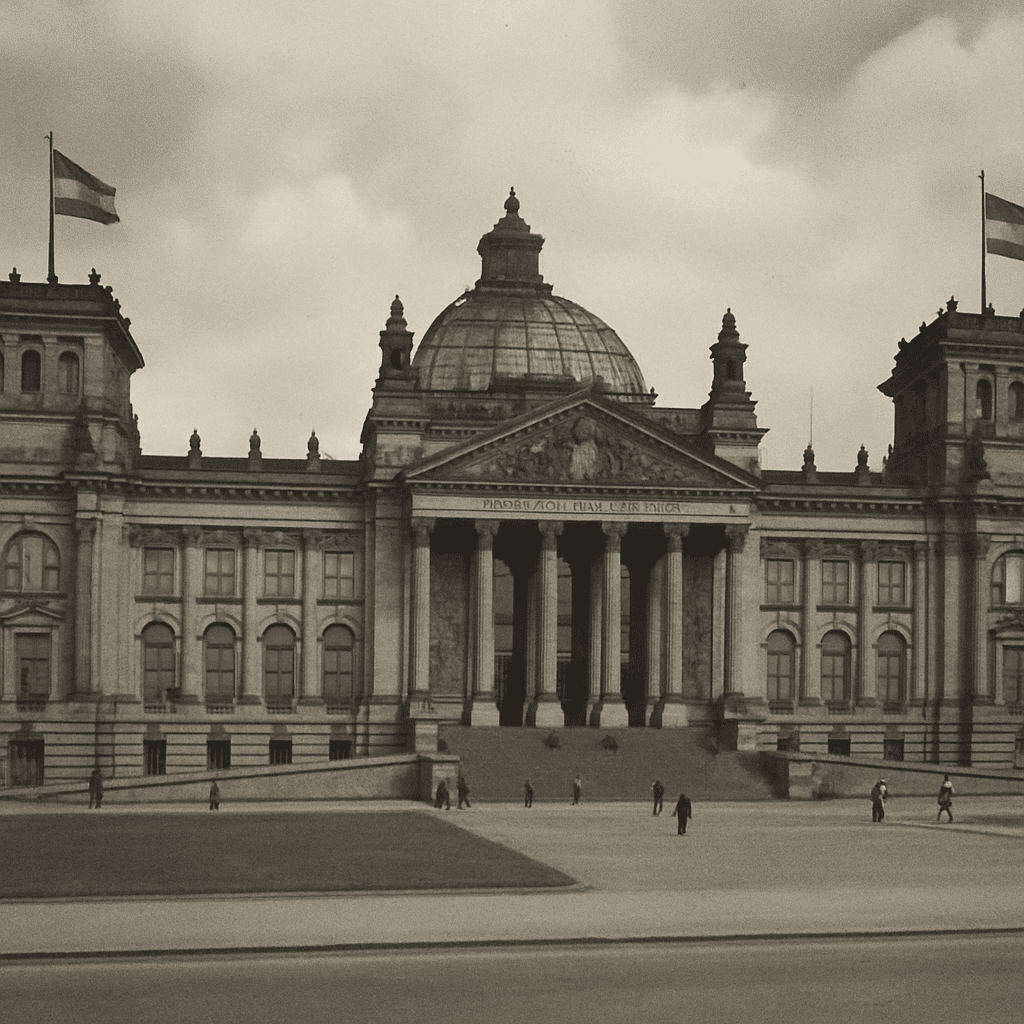
The architecture was impressive even during these turbulent years. Its Neoclassical facade remained a landmark of Berlin.
The Reichstag Fire and the Nazi Era
The Reichstag fire on February 27, 1933, marked a turning point. The National Socialists used it to consolidate their power. The fire served as a pretext for the persecution of political opponents.
In the following period, the totalitarian regime under Hitler established itself. The Reichstag lost its role as a democratic forum. Political decisions were instead made in other bodies.
The Reichstag building suffered from neglect and was hardly used. The Nazi era left traces that remained visible for a long time.
These dark years ended with World War II. The Reichstag was later rediscovered in the 1950s as a symbol of hope.
Destruction, Division, and Reconstruction: The Reichstag in Divided Berlin
During World War II, the Reichstag was heavily damaged. The fighting in Berlin left visible scars of destruction. After the war, the building lay in ruins.
With the division of Germany, the Berlin Wall ran near the Reichstag. The historic building lay in the heart of West Berlin. It stood as a constant reminder of German division.
From the 1950s onwards, a slow reconstruction began. But it was only reunification that brought new momentum. The Reichstag was to become the political center of Germany again.
The reconstruction and renovation in the 90s under Norman Foster's leadership were significant:
- Receipt and modernization of the historic structure
- Integration of contemporary elements
- Construction of the iconic glass dome
These measures symbolized a new beginning and hope for a united future.
Reunification and the Path to the New Bundestag Seat
The reunification of Germany in 1990 was a turning point. The Reichstag in Berlin was to become the parliamentary center. This decision was symbolic of unity.
In 1991, the Bundestag voted for Berlin as the future seat of government. This vote marked the beginning of extensive renovation work. British architect Sir Norman Foster was commissioned.
Between 1995 and 1999, Foster transformed the Reichstag. He combined historical elements with modern architecture. The distinctive glass dome was created during this time.
In 1999, the German Bundestag officially moved into the renovated Reichstag building. This solemn inauguration was a significant moment. Today, the Reichstag is an essential part of the Berlin skyline.
The Architecture of the Reichstag: Historic and Modern United
The architecture of the Reichstag building connects past and present. Originally designed in the neoclassical style by Paul Wallot, the building features many historical details. After the renovation by Sir Norman Foster, modern elements were added.
One of the main attractions is the transparent glass dome. It allows for the utilization of natural light and symbolizes political openness. The innovative construction attracts numerous visitors.
Foster's design aimed for sustainability and functionality. The combination of old and new makes the Reichstag unique. This blend reflects German history.
Key architectural features of the Reichstag
- 19th-century neoclassical style
- Modern, transparent glass dome
- Use of daylight and ventilation
- Symbol for democratic transparency
The Glass Dome: Symbol of Transparency and Democracy
The Reichstag's glass dome is an architectural masterpiece. It was designed by Sir Norman Foster and completed in 1999. Its transparent structure symbolizes the openness of government.
From the dome, you have an impressive view of Berlin. The spiral ramps inside allow visitors to ascend. This structure attracts locals and tourists alike.
The dome uses natural light and provides ventilation. These are important features of sustainable architecture. The design contributes to the building's energy efficiency.
Visiting the dome is free, but advance registration is required. The view and innovative design are definitely worth the visit.
The Reichstag today: Seat of the German Bundestag and Berlin landmark
Today, the Reichstag building serves as the seat of the German Bundestag. It is a vibrant place for political decision-making. Its significance for German democracy is immense.
The Reichstag is also one of Berlin's main attractions. It attracts thousands of visitors from all over the world annually. The impressive architecture draws attention.
In addition to its political function, the Reichstag offers numerous services to the public:
- Tour of the dome and rooftop terrace
- Attendance at a plenary session of the Bundestag
- Exhibitions on German History and Politics
These opportunities offer valuable insights into German history and politics. A visit is worthwhile not only for those interested in politics.
Bundestag Visit: Tips for Visitors
A visit to the Reichstag Building is an unforgettable experience. Visiting the dome is free of charge, but prior registration is required. This ensures a smooth process.
To avoid waiting times, visitors should book in advance. Visits can be arranged online or by phone. Tours are available in multiple languages.
Visitors should wear weather-appropriate clothing, as parts of the tour take place outdoors. Cameras are allowed, and the view from the dome is spectacular.
Here are some tips for a successful visit:
- Plan ahead
- Register online or by phone
- Wear comfortable clothes.
- Bring a camera
- Take a guided tour
Conclusion: The Reichstag as a Symbol of German History and Future
The Reichstag building in Berlin symbolizes Germany's eventful history. From the Imperial era to reunification, it reflects political change.
Its architecture blends old and new, showcasing Germany's pursuit of transparency and innovation. This makes it a fascinating sight.
Today, the Reichstag is a vibrant place of democratic processes. As the seat of the Bundestag, it stands for a hopeful and stable future.