
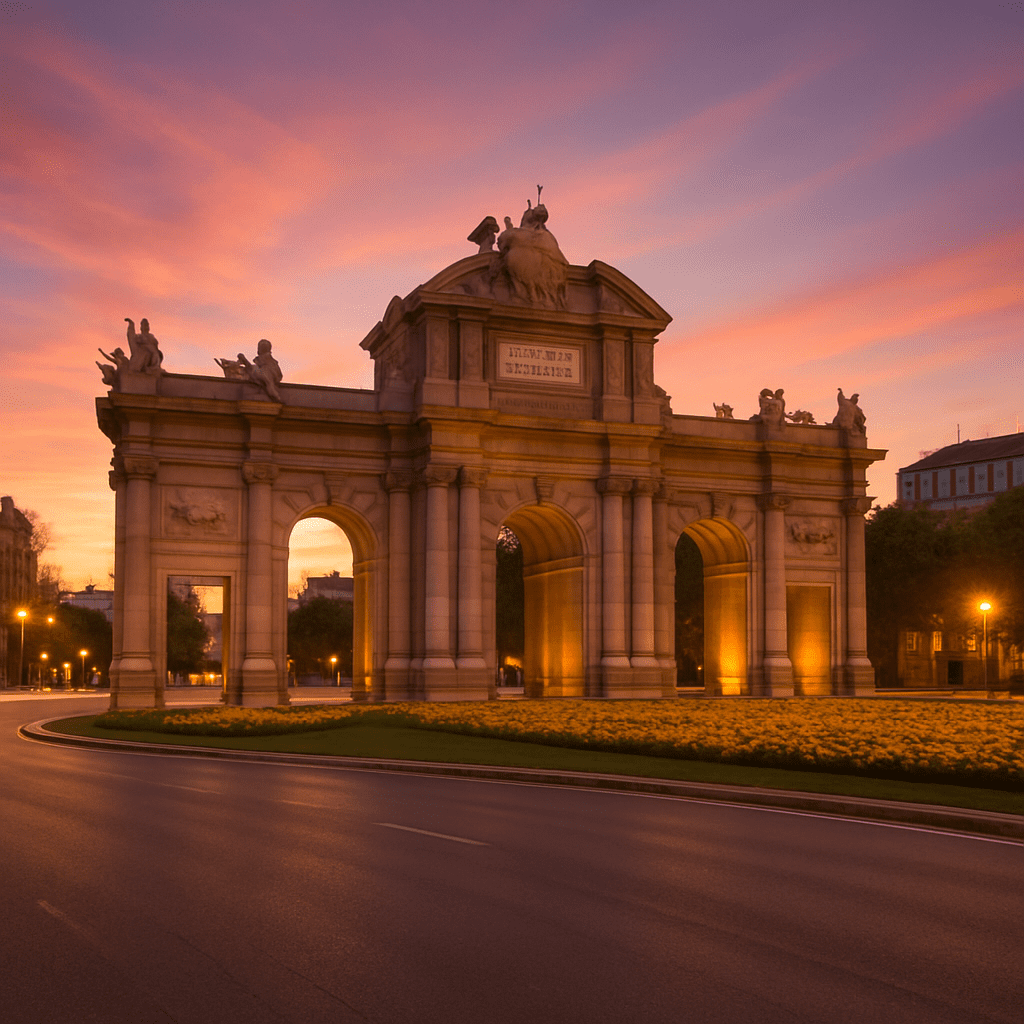
One step onto a dusty road in 1778, accompanied by the clatter of hooves and the din of weary travelers finally reaching Spain's capital. Long before the era of illuminated highway signs, the city required a monumental entrance to impress arriving dignitaries, seeking the finest Madrid Attractions searched.
The Alcalá Gate It was the architectural equivalent of a giant 18th-century urban welcome sign–albeit with considerably more finesse. Historical records attest to a surprising title: this is the first modern triumphal arch built in Europe since the fall of the Roman Empire. King Charles III commissioned this towering historical landmark on commission, as his homeland needed a world-class symbol to compete with the elegance of Paris and establish a true metropolitan identity.
Today, visitors easily fall prey to the temptation to just snap a quick selfie and move on. But this landmark is far more than a mere backdrop for a roundabout; it marks the exact moment Madrid announced its arrival as a modern, global metropolis.
From the Triumphal Arch to the Traffic Hub: Charles III's Vision.
A look at Madrid in the early 18th century reveals a grim picture: instead of splendid boulevards, arriving travelers were met with narrow, dark alleys in a crowded medieval fortress town. This changed radically with King Charles III, who went down in history as the „best mayor of Madrid.“ He had old walls torn down to make way for light, air, and a modern metropolis.
For this ambitious project, the monarch commissioned the architect Francesco Sabatini. His majestic „Sabatini style“ – an elegant blend of Baroque grandeur and strict, clean lines – particularly stands out when we consider architectural styles of major eras in overview. The magnificent gate was built in this precise location for three concrete reasons:
- First, it served as a monumental main entrance for travelers from Aragon and Europe.
- Secondly, it deliberately shifted the city limits eastward to stimulate urban growth.
- Third, it celebrated the triumphant arrival of Charles III as a shining symbol of his royal power.
Visitors to the structure today quickly recognize the practical side of this splendor. The five archways were not merely decorative; they served as a kind of historical traffic control system that strictly segregated society. The three massive, round passages in the center were reserved exclusively for the carriages and horsemen of the nobility, while ordinary pedestrians had to use the two smaller, rectangular outer gates.
Interestingly, this new beginning also held a small secret. To avoid disappointing his royal patron, Sabatini made an unusual decision, which leads us directly to the architectural peculiarities.
The Riddle of the Two Faces: Why the Archway is Asymmetrical
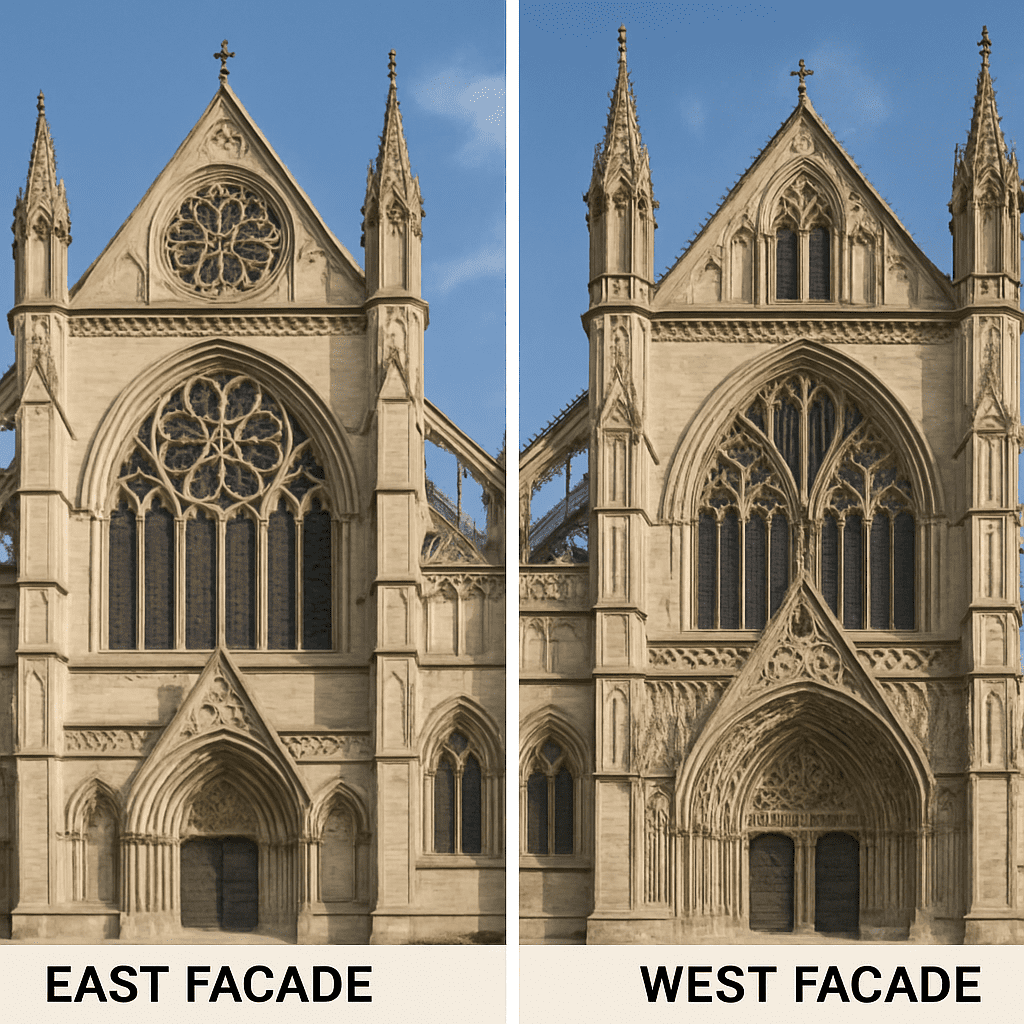
When a royal patron can't make up their mind, creative architectural solutions are in demand. When Francesco Sabatini presented his designs for the Puerta de Alcalá, he showed the king two slightly different sketches. King Charles III was surprisingly so pleased with both versions that Sabatini chose a way out that was as pragmatic as it was clever: He simply built each side differently. Today, anyone walking around the monument literally faces two completely different faces of the same building.
Anyone who looks closely will discover the subtle yet crucial differences. The east-facing exterior facade, which welcomed arriving travelers from Europe, boasts ten magnificent round half-columns to ostentatiously demonstrate the monarch's wealth. On the west-facing interior side, facing the city center, everything appears a bit more subdued; here, flat pilasters—that is, angular columns embedded directly into the wall—support the massive stone structure.
This conscious return to strict Roman ideals makes the gate a prime example of Neoclassicism. Instead of playful flourishes, clear geometry and the masterful contrast of two types of stone were employed. The hard, silver-gray granite forms the indestructible skeleton of the gate, while the softer, light limestone was used for the fine sculptures, which almost glow golden in the late afternoon light.
Today, the building's role has drastically changed from its former function as a border crossing. The constant evolution around its function as a static monument versus a modern landmark amidst Madrid's bustling traffic shows how alive history can be.
More than just stones: Understanding the UNESCO World Heritage Seal
Viewed from a bird's-eye perspective, the gate is no longer an isolated structure, but rather the proud centerpiece of a wide, tree-lined boulevard. This comprehensive viewpoint earned Madrid the coveted World Heritage title in 2021 for the so-called „Landscape of Light“ (Paisaje de la Luz).
The strict criteria of UNESCO World Heritage sites rarely focus solely on the age of the stones, but rather on their concrete benefit to society. The Madrid ensemble particularly impressed the international jury with three key historical aspects:
- Space for Citizens: For the first time in Europe, nature and urban space were consciously merged as a place for strolls for the common people, no longer exclusively for the nobility.
- Science in everyday life: The skillful integration of observatories and botanical gardens made education and research accessible to everyone.
- Global role model This revolutionary, green model served as a direct inspiration for modern urban planning throughout Latin America.
Such oases of recreation demonstrate the enormous importance of historical monuments for urban identity. The residents of Madrid still use these historic thoroughfares today, just as they did centuries ago, for strolling and taking a breath of fresh air, thus keeping this heritage alive in everyday life.
The Fight Against Time: How to Protect Ancient Monuments from Decay
Consider the massive granite blocks of historical structures; they seem almost indestructible. Yet, when experts discuss how to protect ancient ruins from decay, they often look to an invisible enemy in modern metropolises: air pollution. Thousands of cars drive past landmarks daily, their exhaust fumes settling as a fine, aggressive smog onto the centuries-old stone. These pollutant deposits eat into the pores like an invisible sponge, causing the once-robust granite to slowly lose its strength and literally crumble.
To legally counteract this gradual process, far-reaching regulations are implemented. It is important for many visitors to understand the difference between monument protection and existing use protection. While existing use protection merely guarantees that an existing building cannot simply be demolished, monument protection requires active, historically appropriate maintenance. Therefore, it is not just about the monument remaining standing, but about its historical soul – the original materials and details – being preserved for the future.
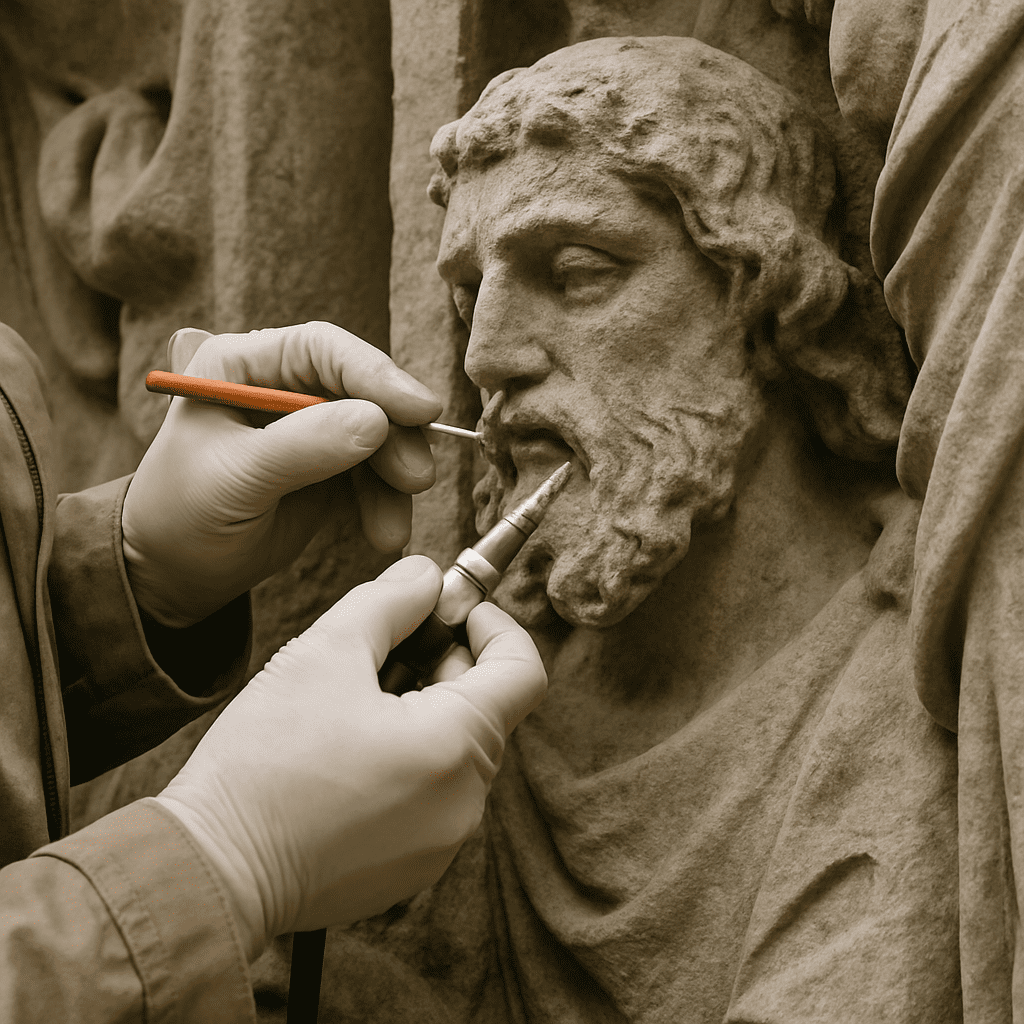
These strict rules make the artisanal rescue a true test of patience. Those who have to calculate the cost of preserving old facades don't count in days, but in years. Restorers tackle the black smog crusts with high-precision lasers and fine brushes – surgical millimeter work where tiny cracks are carefully filled. However, this enormous effort depends heavily on our own behavior.
Sustainable Travel: How to Experience History Without Leaving a Trace
Millions of hands touch the same sandstone over the years. Besides smog, the immense impact of mass tourism on cultural heritage sites is one of the greatest challenges of our time. The modern management of „overtourism“ today tries to cleverly direct visitor flows so that ancient stair steps are not literally ground to dust by the sheer mass of shoes. Every step and every careless touch leaves microscopic traces.
To reduce this human footprint, experts are turning to a fascinating solution: the digital twin. This is essentially a highly precise, virtual 3D clone of the real structure in the computer. Researchers are using this technology to simulate invisible stresses or to prepare the digital reconstruction of destroyed monuments with millimeter accuracy. This way, we can digitally explore hidden corners of a landmark in the future without further wearing down the real stone.
But visitors themselves can also actively help. Here are four simple tips for sustainable cultural tourism at the famous Puerta de Alcalá:
- View the gate from a respectful distance without touching the historical pillars.
- Come early in the morning to avoid the massive crowds in the square.
- Use smartphone audio guides instead of printed disposable brochures.
- Stay on marked paths to protect the old paving.
Your Guide Through History: Why Monuments Shape Our Future
Anyone standing before an old city gate today sees more than just weathered stones. They encounter a silent witness to time, one that has outlasted wars, joyful festivals, and the daily lives of countless generations. This perspective highlights the invaluable significance of architectural monuments for urban identity: they are the stone anchors of our collective memory, making tangible where our roots lie.
Go on a targeted journey of discovery, search for the hidden marks of the stonemasons, and trace history. At the same time, it's not just fresh mortar that ensures the survival of these places today. Digitally archiving cultural heritage has now become a crucial step in saving these majestic structures from time's decay with precise 3D models.
Every time you step through such a gate, you are stepping into vibrant history. Through mindful appreciation and respectful behavior, you actively contribute to preserving this valuable heritage for future generations.