
When you think of Seville, the Andalusian capital, images of fiery flamenco, the majestic Alcázar Palace, and narrow, orange tree-lined streets immediately come to mind. Yet, amidst this historic backdrop lies an unexpected, state-of-the-art marvel and a paradise for gourmands at the same time. The Mushrooms of Seville – affectionately called „Las Setas“ by locals – are far more than just a spectacular photo opportunity.
This article takes you on a journey of discovery, connecting two worlds: the breathtaking architectural masterpiece that spans the city like a mycelial network, and the actual culinary treasures hidden within. Join us from the ancient foundations up to the very tops of this unique construction.
The Visionary: Architecture Meets Urban Renewal
The design, known in professional circles as Metropol Parasol Architecture Jürgen Mayer H, This has literally revolutionized the urban landscape of Seville. German architect Jürgen Mayer H. won the international competition to redesign the square in 2004. His vision: an organic structure that provides shade, preserves historical heritage, and creates a new, vibrant focal point for the city's residents.
Today, the mushrooms Seville, as the building is colloquially known, rises nearly 30 meters into the Andalusian sky. When you look at the World's Largest Wooden Structure Facts When you look at it, you can hardly stop marveling: The structure consists of around 3,500 interwoven wooden elements made of Finnish spruce, which are protected from the intense Spanish sun and weather by a special polyurethane coating.
A Look into the Past: Plaza de la Encarnación History
Before these gigantic mushrooms shot out of the ground, this place looked completely different. Plaza de la Encarnación History is characterized by change and upheaval. Once, a significant monastery was located here, later the city's first covered market, which was demolished in 1973 due to dilapidation. For years, the square lay fallow as an unattractive parking lot and unused wasteland.
When the city finally decided to redevelop the square and build an underground parking garage, the excavators uncovered something unexpected. An archaeological treasure lay hidden beneath the ground: Today's Antiquarium Seville Roman Excavations. Excellent Roman mosaics were found, along with remains of houses from the 1st to 6th centuries and remnants from the Moorish era. This discovery drastically altered the construction plans and led to the integration of the museum into the lower level of the Metropol Parasol.
Culinary Treasures: Edible Mushrooms and the Market Hall
We've talked a lot about the architectural „mushrooms“ so far, but Seville wouldn't be Seville without its excellent gastronomy. The heart of the street-level complex is the Seville's ground-floor market hall (Mercado de la Encarnación). The building picks up on its historical function as a marketplace.
At the lively stalls, locals and tourists find everything a culinary heart desires – including fantastic, actual Edible mushrooms. Especially in autumn, greengrocers' displays transform into a paradise for mushroom lovers:
- King Oyster Mushrooms A staple of Spanish tapas culture.
- Boletus (Porcini): Delivered fresh from the surrounding mountains (like the Sierra Norte).
- Saffron milk cap (Blutreizker): Fried in olive oil with plenty of garlic and parsley, they are an absolute delicacy.
Our tip: Stroll through the market hall in the morning, buy some fresh delicacies, or sit down in one of the small tapas bars right in the market to enjoy freshly prepared mushroom tapas with a cool glass of sherry. Here, the name of the building and Andalusian cuisine merge wonderfully.

A Structural Feat: Construction and Costs
Such an ambitious project naturally didn't go without hurdles. The Construction time and construction of the wooden louvers called for everything the engineers had. The complex, computer-generated honeycomb structure not only had to bear its own immense weight, but also withstand the extreme temperatures of Seville.
Many locals wondered during the long delays: Why did Metropol Parasol become so expensiveThe answer lies in technical feasibility. In the midst of the construction process – in 2007 – it became apparent that the original static calculations for the wooden connections were insufficient. The structure could not support itself. It took years to develop a new, innovative bonding and connection system. This massive delay and the enormous technical effort led to construction costs nearly doubling from the originally estimated 50 million euros to around 100 million euros.
High up: A walk in the clouds
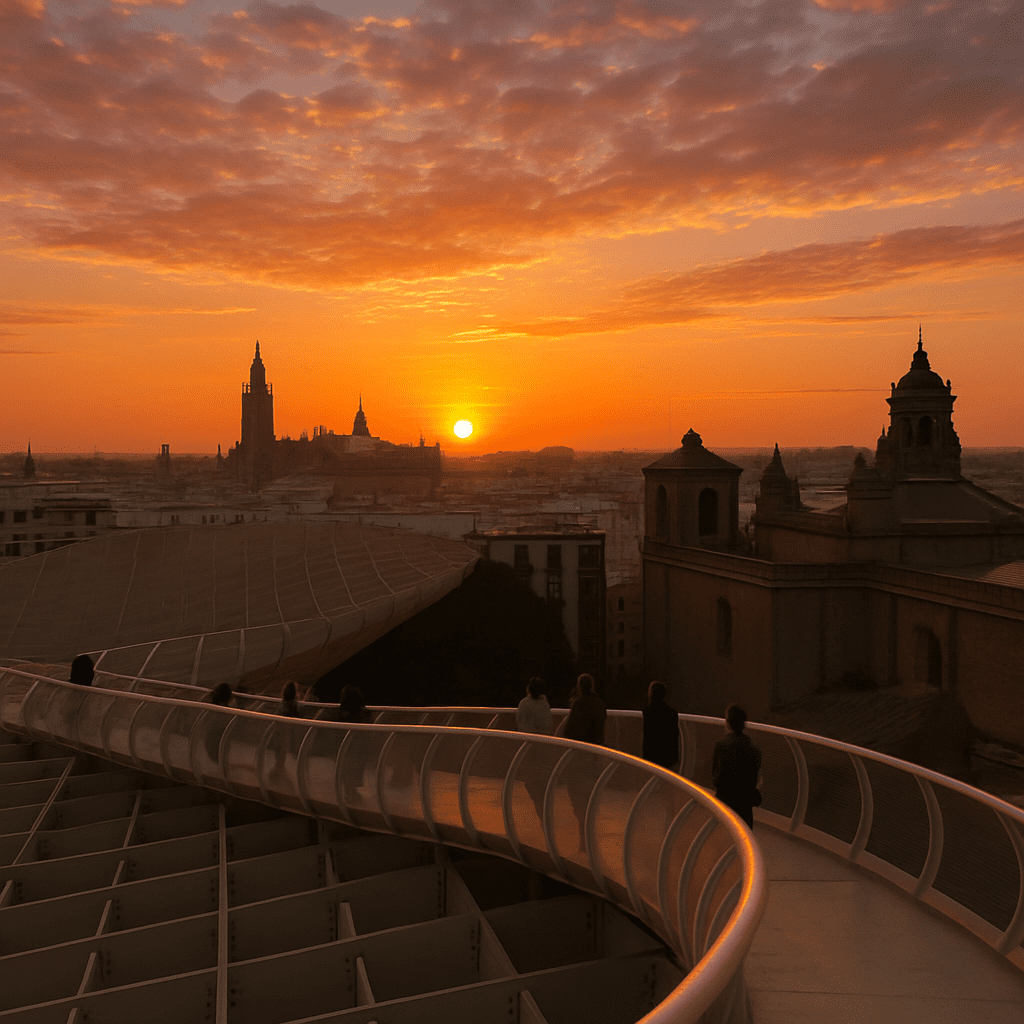
Despite the initial controversies, the „Setas“ are the pride of the city today. The absolute highlight of a visit is the Tour of the floating walkways. On the roof of the structure, a 250-meter-long panoramic walkway winds along the organic curves of the architecture.
The best part? The entire experience is designed to be inclusive. The Accessible access to the roof of Seville spacious elevators ensure that families with strollers, the elderly, and wheelchair users can easily travel from the market hall to the canopy of the structure.
If you're wondering when you should brave this climb: An experience of a lifetime is the Seville viewpoint sunset. As the Andalusian sun slowly sinks below the horizon, it bathes the city and the curved wood of the mushrooms in a magical, golden light. Later in the evening, the building also shines with fascinating, changing LED lighting (called „Aurora“).
Old vs. New: An Urban Contrast
Seville is a city of contrasts. To truly understand the significance of mushrooms, it is worth a Comparison: Metropol Parasol vs. Giralda Tower.
- The Giralda: The historic minaret, now the cathedral's landmark, represents the city's deep religious and historical past. It is massive, built of stone, and classically strives vertically towards the sky.
- Metropol Parasol: The wooden structure represents the future and secular life. It spreads horizontally, provides shade, and brings people together in public spaces.
Besides the Metropol Parasol, there are other Modern attractions in Seville's Old Town, such as CaixaForum or Torre Sevilla. However, none of these buildings so seamlessly combine history (through the Antiquarium), everyday life (through the market), and modern leisure (through the observation deck) as the Metropol Parasol.
Practical tips for your visit
To make your trip to this masterpiece perfect, we have summarized the most important information for you:
- Metropol Parasol Ticket Prices and Opening Hours:
- Opening hours: The observation deck is usually open daily from 9:30 AM to midnight (often until 12:30 AM in the summer).
- Admission Tickets for the observation deck cost approximately 15 Euros for tourists. (Tip: In the evening, there are often special „immersive experiences“ for which you should book tickets online in advance). Admission to the market hall on the ground floor is, of course, free.
- Best time for photos at the Metropol Parasol:
- For architectural shots without large crowds, early morning right after sunrise (photographed from the street) is recommended.
- For panoramic city views from above, the late „golden hour“ just before sunset is unbeatable.
- Getting to Metropol Parasol by bus:
- The property is super centrally located on the Plaza de la Encarnación. For the Getting to Metropol Parasol by bus It is best to take lines 27 or 32, which stop directly nearby (Plaza del Duque or Ponce de León stop). From there, it's only a few minutes' walk. Alternatively, you can reach the building from the cathedral in about a 15-minute walk.
Conclusion: A feast for the eyes and palate
The Mushrooms of Seville are a fascinating testament to how modern architecture can revitalize a city without erasing its history. From the Roman ruins in the Antiquarium to the bustling activity in the market hall and up to the futuristic, suspended walkways, the Metropol Parasol offers a journey through time.
Whether you're coming for the groundbreaking wooden architecture, want to photograph stunning sunsets, or are hunting for culinary inspiration and fresh wild mushrooms for your next tapas dish in the market hall: this landmark should not be missed on any trip to Seville. Let yourself be captivated by the Andalusian way of life and discover the many facets of the world's most fascinating mushrooms!