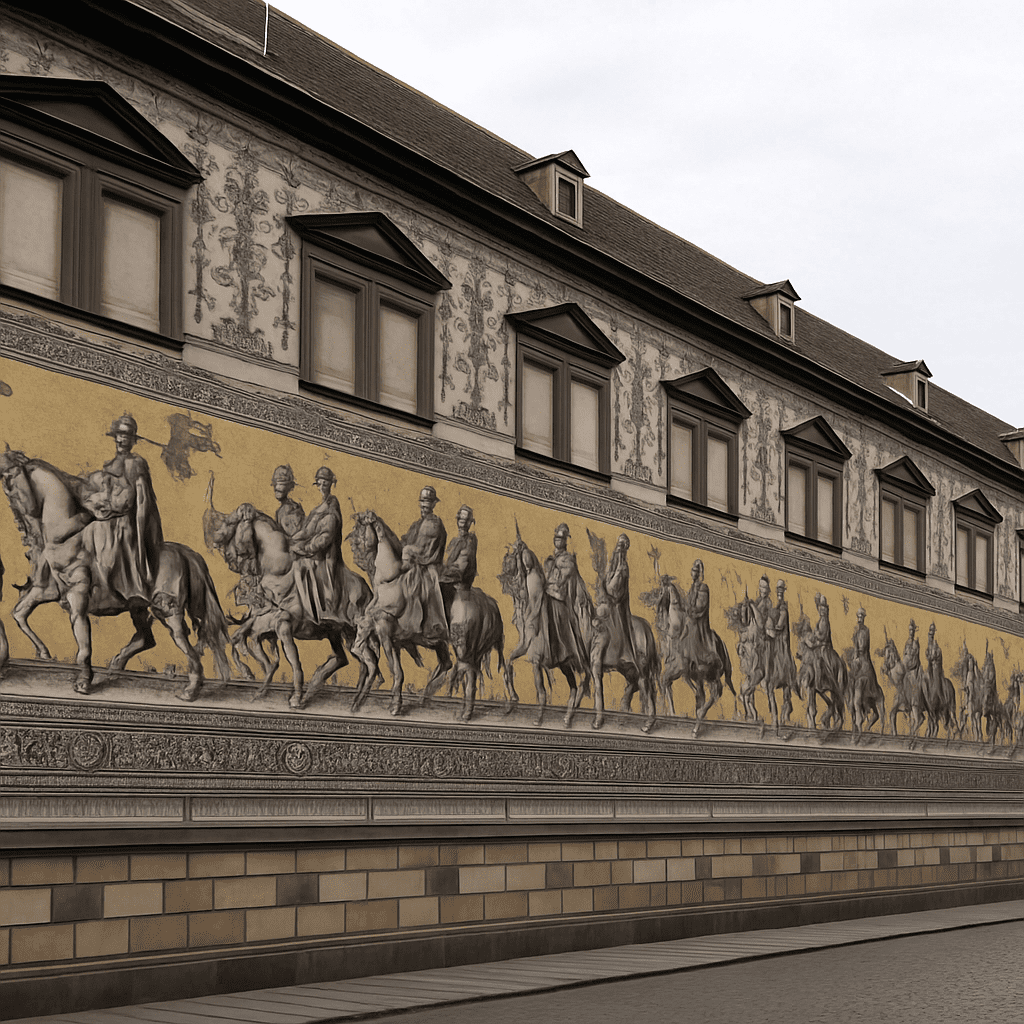
As you stroll through the cobblestone streets of the Saxon state capital, you inevitably come across a work of art that, quite literally, takes your breath away: the Procession of Princes in Dresden. This colossal mural is not only a masterpiece of craftsmanship but also a stone (or rather, porcelain) chronicle that brings almost a millennium of Saxon history to life. As one of Europe's most impressive and historic open-air artworks, it attracts millions of visitors annually.
In this article, we dive deep into the captivating history of this monumental work. We shed light on the artistic transformation, the hidden symbolism, and reveal why this masterpiece should be at the top of your list of must-see Dresden attractions.
A Monumental Anniversary: The Origins of the Artwork
The history of the Procession of Princes begins in the late 19th century. In 1889, the House of Wettin, the Saxon ruling dynasty, celebrated its 800th anniversary. In honor of this historic milestone, it was decided to redesign the outer wall of the stable yard, which connects the Neumarkt to the Schlossplatz. In international historical publications, this project is often reverently referred to as the 800th anniversary of the House of Wettin monument described.
The prestigious commission was awarded to the German artist Wilhelm Walther. Those who are interested in The House of Wettin mural has a rich and fascinating history. It depicts the lineage and key figures of the House of Wettin, a noble German dynasty that has reigned in various territories since the 11th century. The specific mural you're referring to likely dates back to the 19th century. It was commissioned during the reign of King John of Saxony (1801-1873), who was a member of the Ernestine line of the House of Wettin. The mural was created by the painter Julius Schnorr von Carolsfeld for the *Stadtschloss* (City Palace) in Dresden. The mural is a large, elaborate fresco that traces the ancestry of the Wettin family from its mythical founder, Wettin, all the way up to the ruling monarchs of Saxony at the time. It is significant for several reasons: * **Genealogical Representation:** It serves as a visual chronicle of the dynasty's historical importance and its claim to legitimacy through a long and distinguished lineage. * **Artistic Style:** Schnorr von Carolsfeld was a prominent figure in the Nazarene movement, which aimed to revive the spirit of early Renaissance and medieval art. The mural reflects this style with its detailed figures, rich colors, and often allegorical elements. * **Political Context:** The mural was created during a period of German unification and the rise of nationalism. By showcasing the history of the Wettin dynasty, it contributed to the image of Saxony as a historical and culturally significant kingdom within the emerging German Empire. * **Preservation:** While the original *Stadtschloss* was heavily damaged during World War II, the mural itself was carefully removed and preserved. It is now displayed in the *Residenzschloss* (Royal Palace) in Dresden, which was rebuilt and restored. In essence, the House of Wettin mural is more than just a painting; it's a historical document, an artistic masterpiece, and a symbol of dynastic pride and continuity. Anyone interested will inevitably come across Walther's fascinating vision: He wanted to design a gigantic equestrian procession that would depict all the significant rulers of the Wettins in chronological order.
A brief look into the Wilhelm Walther (1825-1900) was a German painter and historian. He is known for his historical paintings, particularly those depicting scenes from Prussian history. Walther also worked as a professor at the Dresden Academy of Fine Arts. shows that the artist studied historical documents, armor, and paintings for years to ensure that every detail – from the weapons to the horses' harnesses – was historically accurate. As a charming detail on the sidelines: Walther immortalized himself at the end of the procession. He walks as one of the last figures in the procession and looks the viewer directly in the eye.
From crumbling plaster to eternal porcelain
The original version of the Procession of Princes, created between 1872 and 1889, was by no means made of porcelain. Walther used the sgraffito technique. Art historians still often debate the pros and cons in the discussion about Sgraffito vs. Porcelain Tile Technique.
With sgraffito, different colored plaster layers are applied, and then the motif is scratched out. Unfortunately, this technique was not suitable for Dresden's harsh climate, which was marked by soot at the time. The artwork began to fade and crumble dramatically around the turn of the century.
To save the masterpiece for eternity, a radical decision was made between 1904 and 1907: the fresco was to be transferred to Meissen porcelain.
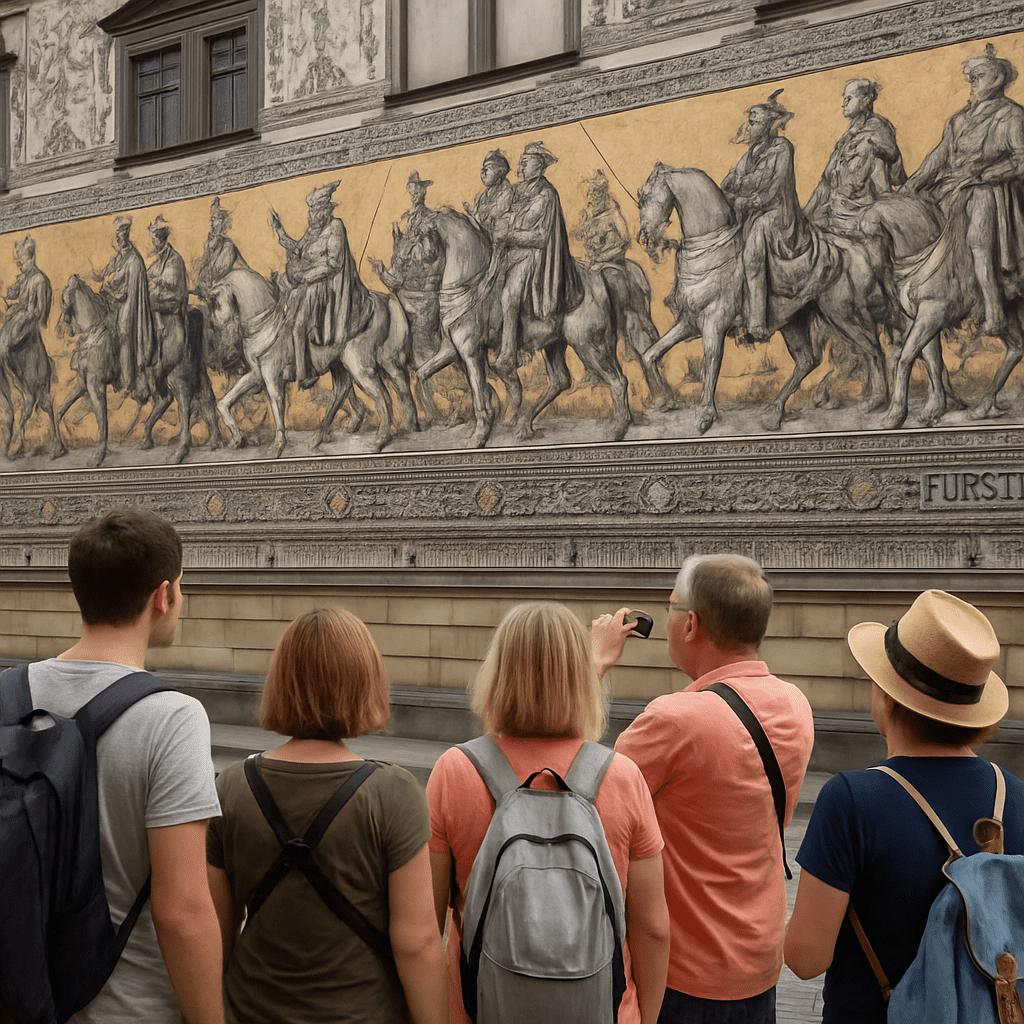
Today, this masterpiece is considered the undisputed prime example of Meissen porcelain tiles outdoor art. With a breathtaking length of 102 meters and consisting of approximately 23,000 seamlessly joined tiles, it has made its international reputation as Largest porcelain mural in the world rightly deserved. The production of the tiles in the Meissen porcelain manufactory required the utmost precision, as the tiles shrink during firing, and the motif had to fit together millimeter-perfectly in the end.
Who Rides There? Deciphering the Ancestral Gallery
International guests almost always ask the same question on tours: The figures on the Dresden porcelain wall are mythological figures from Greek mythology and allegorical figures. They were created by the Meissen porcelain manufactory in the 18th century.The answer is a vivid history lesson. The mural depicts a total of 94 people, including 35 margraves, dukes, electors, and kings from the House of Wettin. They are accompanied by 59 scientists, artists, craftsmen, soldiers, farmers, and children.
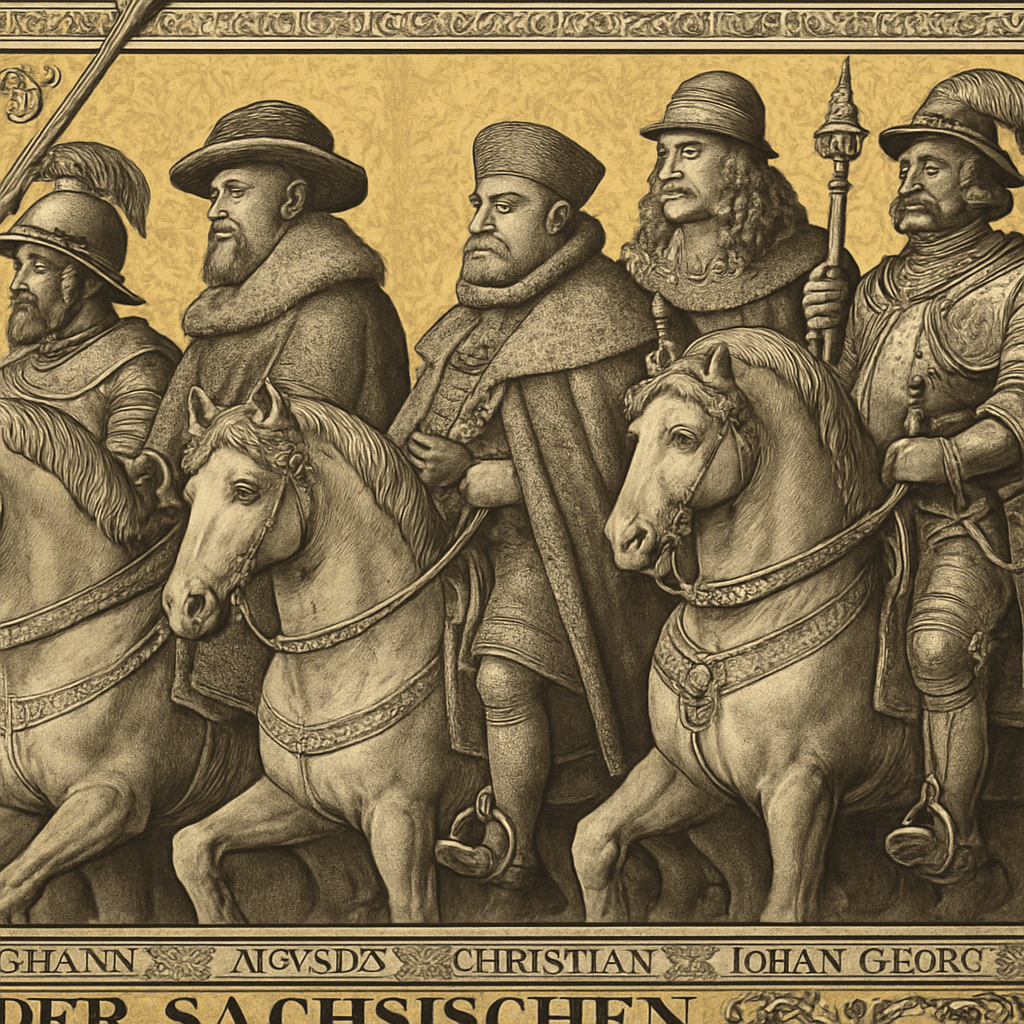
The Identifying Saxon rulers in the procession is fortunately feasible for every visitor. Under each ruler, their name and reign are noted. The train begins with Konrad the Great (1127–1156) and ends with King George (1902–1904).
Particularly noteworthy is the The symbolism of the Saxon procession mural is rich and multifaceted, often reflecting the beliefs, social structure, and worldview of the Anglo-Saxon period. While interpretations can vary, here are some common symbolic elements and their potential meanings: * **The Figures Themselves:** * **Kings and Nobles:** Their presence signifies authority, power, and divine right. They would have been seen as divinely appointed rulers, responsible for the well-being of their people. * **Clergy (Priests, Monks):** Their inclusion highlights the deep religious faith of the Saxons and the significant role of the Church in their society. They represent spiritual guidance and the path to salvation. * **Warriors/Soldiers:** This symbolizes protection of the realm, defense against enemies, and the martial values esteemed by Saxon society. They ensure order and security. * **Craftsmen and Laborers:** Their depiction acknowledges the importance of skilled labor and the common people in building and sustaining society. It suggests a recognition of different social strata and their contributions. * **Women:** Their presence can symbolize fertility, domesticity, and the continuation of the lineage. Depending on their attire and context, they might also represent specific social roles or virtues. * **The Procession Format:** * **Order and Hierarchy:** A procession implies an ordered movement, often from one significant place to another (e.g., from a secular to a sacred space, or from an earthly realm to a heavenly one). This order can symbolize the hierarchical structure of Saxon society, both earthly and divine. * **Journey/Pilgrimage:** The act of processing can represent a spiritual journey, a pilgrimage towards salvation, or a transition from one state to another (e.g., life to death, paganism to Christianity). * **Community and Unity:** A procession brings people together for a common purpose, symbolizing the unity of the community or the church. * **Specific Objects or Attributes:** * **Religious Symbols:** Crucifixes, chalices, books, and other religious artifacts represent faith, worship, and the sacraments. * **Weapons (Swords, Axes):** These symbolize martial prowess, justice, and the king's power to enforce law and order. * **Tools of Trade:** Depictions of tools can represent the specific crafts and industries vital to the Saxon economy. * **Crowns or Regalia:** These are direct symbols of royal power and authority. * **Animals:** Depending on the animal, they can carry various symbolic meanings. For example, a lion might represent strength or royalty, a dove peace, and a serpent evil. * **Context of the Mural:** * **Location:** If the mural is in a church, it likely emphasizes the role of religion in Saxon life and possibly a scene from biblical history or a hagiography (life of a saint). If it's in a secular building, it might focus more on secular power and societal structure. * **Historical Period:** The specific era within the Saxon period can also influence the symbolism. For instance, early Saxon murals might have more overt pagan influences, while later ones would be more intensely Christian. In essence, the Saxon procession mural often serves as a visual narrative, celebrating the social order, religious devotion, and the idealized governance of Anglo-Saxon England. It conveys a sense of purpose, hierarchy, and the interconnectedness of the sacred and the secular.:
- The Development of Weapons At the beginning of the procession, the rulers wear heavy armor, shields, and medieval swords. The further you look to the right, the more modern the clothing and weapons become, up to the fine uniforms of the modern era.
- The clatter of the horses' hooves Some horses have both legs on one side in the air (pace), which only occurs in real horses after special training. This symbolizes the ordered, majestic course of history.
- The absence of the last king: The last Saxon king, Frederick Augustus III, is missing from the procession because at the time of its creation, he had not yet ascended the throne.
- Augustus the Strong: He is easily recognizable because his horse is trampling a rose— a symbol of transience or, according to another interpretation, an indication of the subordinate role of the rose (England) to Saxon-Polish power.
Architecture and Environment: The Perfect Setting
The mural is located on Augustusstraße, a lane that connects Neumarkt at the Frauenkirche with Schlossplatz. Augustusstraße architecture Dresden forms a picturesque and acoustically fascinating backdrop for this artwork. The high walls on the right and left almost make the horses' steps audible as one follows the long line of riders.
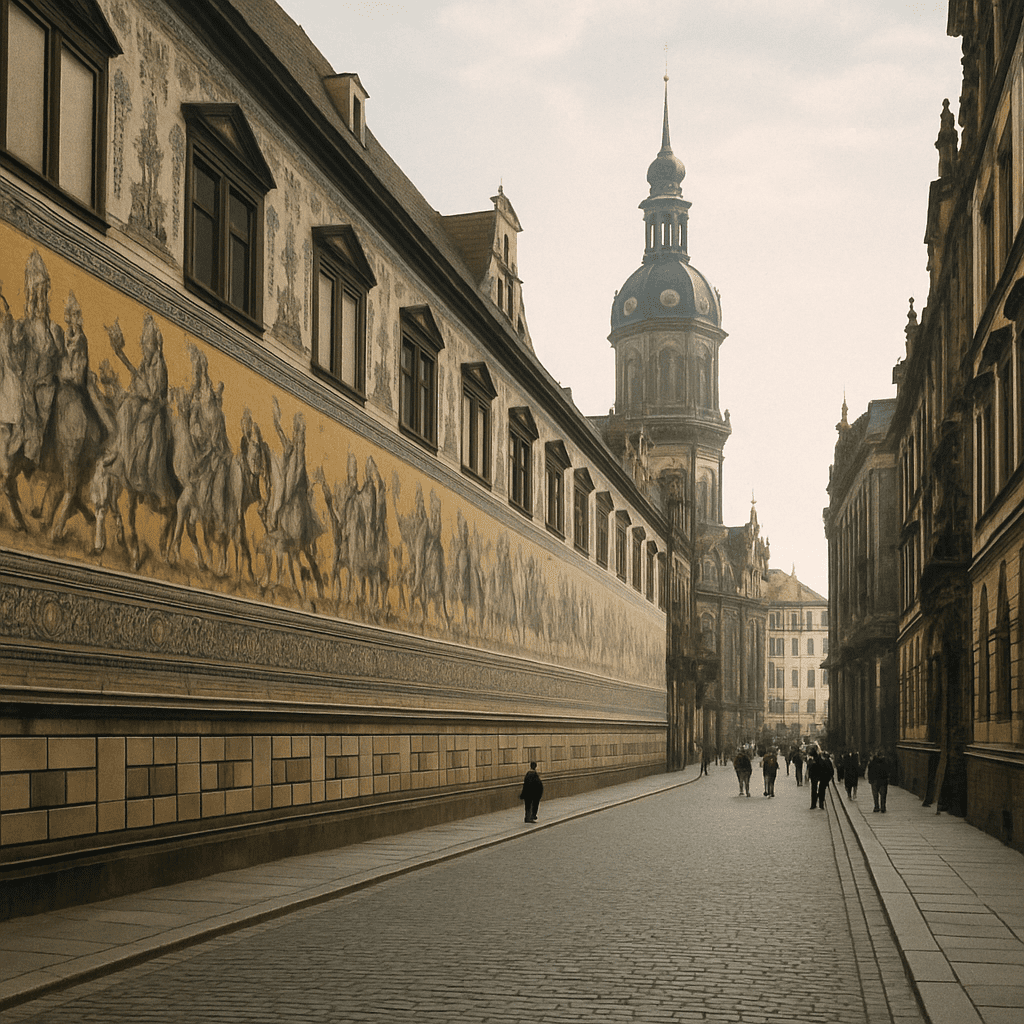
The Prince's Procession is therefore an indispensable highlight of any Dresden Frauenkirche walking tour. The residential palace, where the Wettins once resided, is just a few meters away. The wall on which the artwork is mounted belongs to the rear of the historic Stallhof.
This stable yard is not only architecturally significant. Those who visit Dresden at the right time can attend wonderful events here. The square is known far beyond the city limits for numerous Stallhof Dresden cultural events. Especially in the Advent season, the courtyard transforms into a medieval Christmas market, which is considered one of the most atmospheric in all of Germany.
A Miracle in the Firestorm: Survival 1945
When looking at the pristine, radiant tiles today, many observers inevitably ask themselves: How the mural survived World War II bombing?
In February 1945, Dresden was reduced to rubble and ashes by devastating Allied bombing raids. The historic Old Town, including the Royal Palace and the Church of Our Lady, also fell victim to the flames. Miraculously, however, the Procession of Princes was almost entirely preserved.
The secret to its survival lies in the material itself. The Meissen porcelain had been fired at over 1,400 degrees Celsius during its production. When the firestorm swept through the streets of Dresden, the temperatures were not high enough to melt or destroy the heat-resistant porcelain. The wall of the Stallhof, built massively enough, also withstood the pressure waves and did not collapse. Only about 200 of the 23,000 tiles were damaged by shrapnel and were faithfully restored in the years 1979 to 1980.
Practical tips for your visit
An visiting the Procession of Princes is wonderfully uncomplicated. Unlike many other attractions, this open-air artwork is accessible at all times.
Here are some practical tips for your travel planning:
- Free Experience: The Procession of Princes in Dresden is free to enter. It is undoubtedly one of the best free historical landmarks in Dresden's Old Town and saves your travel budget.
- The best time of day: If you want to take breathtaking photos, come in the early morning or at dusk. Augustus Street can be very crowded during the day. The gold accents of the porcelain glow particularly beautifully in the soft morning light.
- City tours To discover the many hidden details, it's worth taking a guided tour. Specifically look for tours related to the „Fürstenzug Dresden,“ as these are often integrated into general Old Town tours.
- Location and Connectivity: The Procession of Princes is absolutely central. In the immediate vicinity, you will find other top Dresden sights such as the Frauenkirche, the Semperoper, the Zwinger, and the Brühlsche Terrasse. Everything is easily accessible on foot.
Conclusion: A time travel on porcelain
The Procession of Princes is far more than just a painted wall. It is an open history book, a masterpiece of Saxon craftsmanship, and a symbol of the survival of an entire city. From its knightly beginnings under Konrad the Great to the elegant modern era, this mural takes every viewer on a visual journey through 800 years of dynastic history.
As you stroll through Augustusstraße, take the time to admire the intricate details of the Meissen tiles up close. It is precisely this unique combination of historical depth, artistic brilliance, and incredible will to survive that makes the Procession of Princes in Dresden an unforgettable experience for every visitor. Don't miss this world's largest porcelain image on your next city trip!