
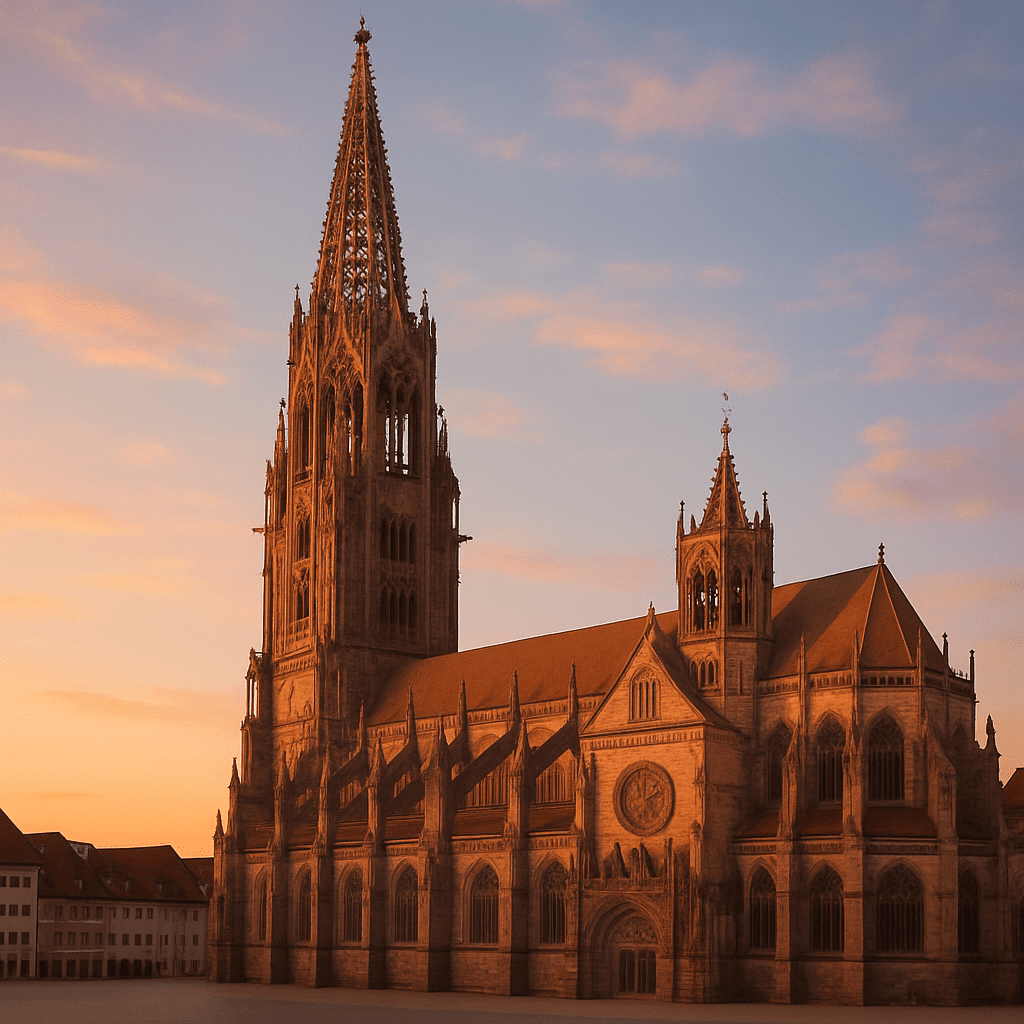
Imagine standing before a massive stone structure that feels less like a fortress and more like a delicate, light-filled cage. In the early Middle Ages, builders favored the Romanesque style – thick, dark bunkers that merely served to prevent heavy ceilings from collapsing. But as medieval builders perfected their craft, they traded these windowless walls for breathtaking vertical height, creating spaces that felt miraculously airy rather than oppressive.
Nowhere is this dramatic transformation more evident than at the Freiburg Minster. According to architectural historians, this cathedral represents the ultimate expression of Gothic architecture: a 116-meter-high tower made entirely of pierced stonework (tracery). Imagine this pierced stone carved so precisely that it resembles a towering net of delicate lace, through whose skeleton wind and sunlight flow unimpeded.
Miraculously, this seemingly fragile spire survived the devastating bombings of World War II in 1944 and stands today as a testament to brilliant medieval craftsmanship. Instead of viewing these towering monuments as inexplicable magic, the stones tell a story of how ancient engineers defied gravity to create seemingly weightless structures out of glass and rock.
Out of the Bunker: How Gothic Builders Traded Thick Walls for Light
Before the 12th century, entering a massive church felt like walking into a stone bunker. Early medieval builders relied on the Romanesque style, which faced a massive weight problem. Much like a heavy backpack, the sheer weight of stone in a traditional barrel-vaulted ceiling pushes outward. To keep these ceilings from collapsing, builders needed incredibly thick walls with tiny windows, which kept interiors dark.
Everything changed near Paris when Abbot Suger rebuilt the Basilica of Saint-Denis. He believed that radiant light and medieval ecclesiastical spaces were deeply connected to the divine. To achieve this, builders developed structural innovations that revolutionized architecture. The differences between Romanesque and Gothic styles are easily recognizable today, whether in the towering French cathedrals or their broader English counterparts:
- Wall thickness Fortress-like stone gave way to thin, skeletal frames.
- Window size: Tiny wall slits became massive stained-glass windows.
- Arc shape Rounded tops transformed into sharp points.
Replacing heavy stone with delicate glass required a complete rethinking of structural load distribution. Directing the roof's weight straight down instead of outward was the secret to achieving these dizzying heights.
The Architectural „Cheat Code“: Mastering Pointed Arches and Flying Buttresses
The path to monumental glass walls begins with a simple geometric adjustment. While earlier, rounded arches pushed the crushing weight of stone outward, the development of pointed arches altered the path of gravity. By directing heavy loads straight down into supporting columns, builders finally eliminated the need for thick, massive walls to counteract lateral pressure.
A glance up at a Gothic ceiling reveals the second technical trick. Instead of building heavy ceilings, stonemasons pioneered the construction of medieval rib vaults. The principle is similar to an everyday umbrella: Sturdy metal ribs hold the shape, allowing the fabric to remain incredibly thin. In cathedrals, intersecting stone ribs take on the structural stress, allowing the spaces in between to be filled with a light „stone skin.“ This drastically revolutionized the weight distribution in masonry vaults.
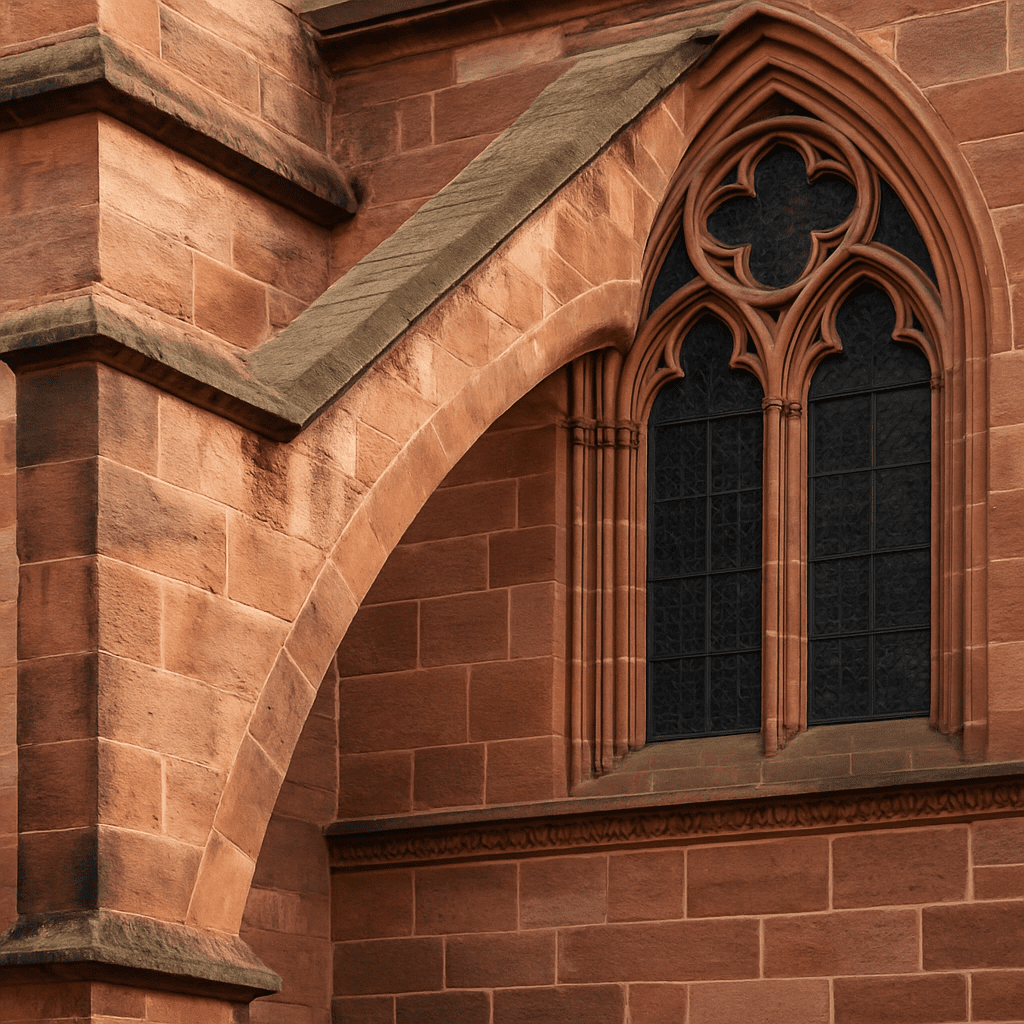
Even with lighter ceilings and downward-sloping arches, the remaining outward pressure – known as lateral thrust – threatened to collapse the tall walls. Architects solved this problem by shifting the supporting structure outward. They designed external stone arms that reach upward, pressing against the upper walls exactly where the roof pushes outward. The structural purpose of this buttressing works like a person leaning their shoulder against a tipping bookshelf, providing vital support without blocking sunlight.
United, these three innovations transformed stone bunkers into towering, sun-drenched skeletons. Once the builders had mastered this delicate balancing act of forces, they pushed their new architectural rules to the absolute limit.
The Broken Masterpiece: Why Freiburg's Tower is a Global Engineering Icon
While traditional French cathedrals favored massive, imposing twin towers, German master builders pushed their newfound structural freedom to an astonishing extreme at Freiburg Minster. They crowned their cathedral with a single tower of pierced tracery—a soaring pyramid of carved stone that looks more like delicate lace than a heavy roof. Instead of piling blocks into an impenetrable wall, the craftsmen carved away as much material as was mathematically possible.
Withstanding centuries of fierce Alpine storms required more than luck; it demanded mastery of unseen forces. The secret to the tower's persistence is its wind permeability. With the structure remaining largely hollow, fierce gales can pass harmlessly through the gaps, rather than colliding with a solid surface. This clever effect required incredibly precise medieval masonry techniques to ensure the remaining slender stone latticework wouldn't buckle under its own weight.
Below this airy pinnacle, the strategy of using empty space continues. Even the huge circular opening on the main facade relies on the crucial structural function of the rose window. Interlocking stone spokes distribute the crushing wall pressure like a bicycle wheel, so the fragile glass doesn't shatter. This brilliant balance of void and solid rock reveals a fundamental truth about these builders: their most beautiful architectural features always solved a tangible physical problem.
More than just decoration: The practical logic of stained glass and gargoyles
When one looks at a shimmering cathedral facade, one might assume that the massive round window is purely decorative. However, it serves an indispensable structural function. To prevent the enormous opening from collapsing under its surrounding weight, the master builders developed tracery – a network of interlocking stone ribs. Like the metal spokes of a heavy-duty wheel, this intricate stonework supports the walls and allows delicate glass to safely fill the empty space.
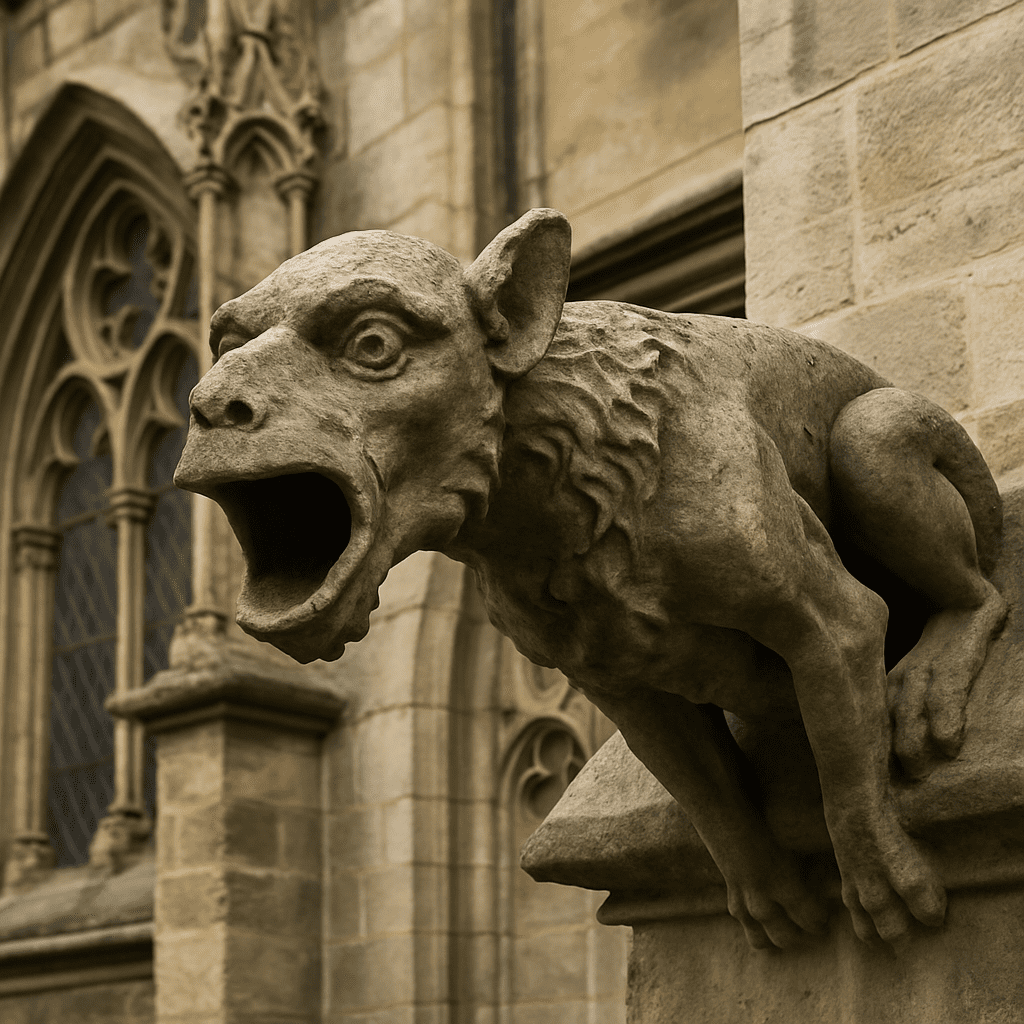
Higher up along the roofline, fearsome stone monsters that jut out from the walls are, in reality, marvels of medieval drainage engineering. The true purpose of gargoyles on cathedrals is highly practical: they function as decorative gutters. By hurling heavy rainwater far from the building's foundation through their open mouths, these monstrous guardians protect the structural mortar from eroding over the centuries.
Inside the sanctuary, the vibrant light streaming through these openings offered more than just atmosphere. Before the widespread proliferation of literacy, intricate visual storytelling known as iconography transformed these soaring spaces into educational tools, cementing the symbolism of stained-glass windows as the „Bible of the poor.“.
Gothic Evolution: How to Recognize Rayonnant, Flamboyant, and „False“ Gothic
Once the builders had mastered their basic engineering skills, they began to experiment. During the Rayonnant and Flamboyant styles the focus shifted from pure height to extreme decoration. Rayonnant architecture focused on radiating geometric patterns, turning rose windows into huge stone kaleidoscopes. Later, Flamboyant designers distorted these clear forms into wavy, flame-like curves, making solid rock look like melting wax.
On the other side of the English Channel, architects pursued a significantly different aesthetic approach. The Perpendicular Style in English Cathedrals preferred strict, grid-like vertical lines over swirling, curved forms and directed the gaze straight upward. In contrast, German Gothic builders created cavernous „hall churches“ in which the side aisles reached the same height as the main ceiling, causing the traditional tiered walls to disappear in favor of a much wider spatial experience.
A leap into the 1800s shows how Victorian builders began enthusiastically copying these marvels. With this four-step checklist, you can Characteristics of Gothic Revival easily identify
- Perfect Symmetry Authentic medieval cathedrals are often notoriously asymmetrical due to centuries of construction; Gothic Revival buildings, on the other hand, are meticulously balanced.
- Machine-cut stone: Pay attention to uniformly smooth masonry instead of irregularly hewn blocks.
- Hidden Iron Gleaming metal bolts and brackets often betray modern industrial skeletons supporting the „ancient“ facade.
- Civil function Train stations, universities, or courthouses that bear dramatic gargoyles are undeniably 19th-century buildings.
Recognizing these subtle structural clues transforms a casual city stroll into a captivating historical architecture exploration.
‚Reading‘ a Cathedral: Insights for Your Next Visit
Those who may have previously perceived Gothic architecture as merely a collection of dark, spiky buildings can now recognize the brilliant technical skeleton behind its beauty. Standing directly in front of Freiburg Minster, it becomes clear exactly what is holding up this massive stone roof. The architectural masterpieces can be mentally checked off: pointed arches guiding the crushing weight downwards, ribbed vaults that span the ceiling like an umbrella, and buttresses leaning like an external scaffolding to protect the glass-filled walls from buckling.
This breathtaking symbiosis of light and height was not achieved by magic, but by masterful medieval stonemasonry. Anyone who witnesses these structural secrets in action during a visit on-site immediately understands how generations of builders transformed heavy rock into a soaring, light-filled legacy for eternity.