
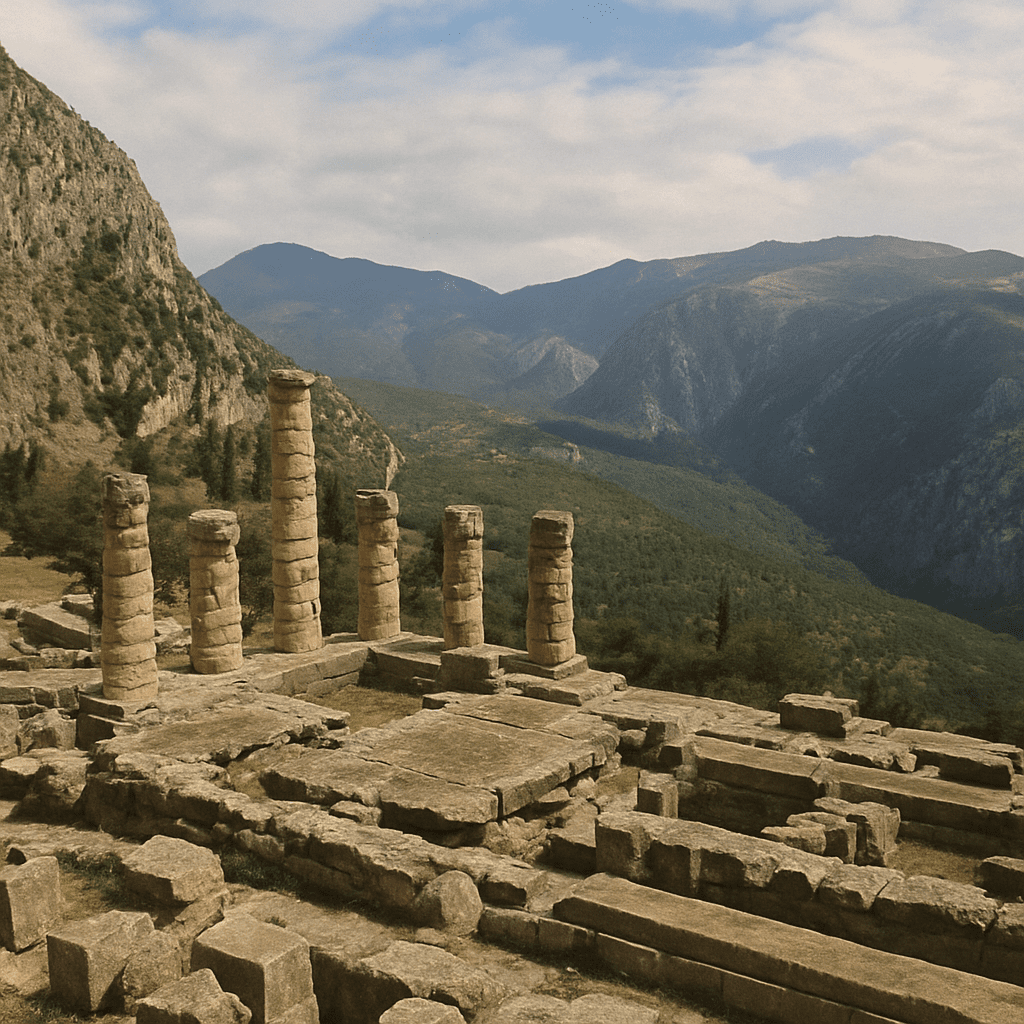
The Temple of Apollo at Delphi is a fascinating testament to the ancient world. It is located at the foot of the majestic Mount Parnassus and has captivated people for centuries. In Greek mythology, Delphi was considered the navel of the world, a place of immense spiritual and cultural significance.
The temple was dedicated to the god Apollo, who was worshipped as the god of light, music, and prophecy. Built in the 4th century BC, the temple was the centerpiece of the Oracle of Delphi. Here, the Pythia, the temple's priestess, proclaimed her famous oracles.
The Temple of Apollo was more than just a religious site. It was an important cultural and political center in ancient Greece. People from all over the Greek world made pilgrimages to Delphi to seek counsel and wisdom. The temple was a symbol of the unity of the Greek city-states and a place where important political decisions were made.
The temple's architecture is an impressive example of the Doric style. Despite multiple destructions and reconstructions, the temple has retained its majestic presence. The ruins, still visible today, bear witness to the splendor of past times.
The Temple of Apollo was part of a larger sanctuary that also included a theater and a stadium. These sites were venues for religious festivals and cultural events that shaped Greek culture. The temple was a meeting place where people fulfilled their spiritual needs and strengthened their connection to the gods.
Today, the ruins of the Temple of Apollo are a major tourist attraction and a UNESCO World Heritage site. They attract history buffs, archaeologists, and culture enthusiasts from all over the world. The temple remains a place of inspiration and a symbol of ancient Greece's power and influence.
The Temple of Apollo at Delphi is not only an archaeological wonder but also a living testament to Greek mythology. Its stories and legends have fueled the imaginations of poets and artists for centuries. The temple is a place where the past remains alive and the future is inspired.
The Significance of Delphi in Greek Mythology
Delphi plays a central role in Greek mythology. It is considered the „Omphalos,“ or navel of the world. This place symbolizes the union of sky and earth. According to one myth, Zeus placed the navel stone to mark the center of the world. This story gives Delphi a cosmic significance deeply rooted in Greek culture.
Apollo chose Delphi as the site of his most significant sanctuary. According to legend, he defeated Python, a terrible serpent that terrorized the area. This event made Apollo the master of the place and marked the beginning of his worship there. The Pythian Games, a type of competition in honor of Apollo, commemorate this triumph. Such myths underscore the importance of Delphi as a sacred site.
The Temple of Apollo at Delphi was not just a religious center. It was also a symbolic place of prophecy. The oracles, proclaimed by the Pythia, were significant messages from the gods. Kings and statesmen relied on these oracles for important decisions. This connection between divine inspiration and worldly rule lent Delphi its impressive authority.
In Greek mythology, Delphi symbolizes the pursuit of knowledge and truth. The famous phrase „Know thyself“ was inscribed on the temple walls. It encouraged people towards self-awareness and wisdom. Such philosophical ideas made Delphi a center for intellectual and spiritual insight. It was a place where people contemplated their existence and their relationship with the gods.
The significance of Delphi is also reflected in the multitude of myths associated with this place. These stories offered the Greeks explanations for natural phenomena and divine order. Examples of such important stories include:
- Zeus and the Omphalos: Determination of the world's center.
- Apollo and Python: Conquest and founding of the place by Apollo.
- Oracle of the Pythia: Divine Guidance of Kings and Heroes.
- Pythian Games Festival of Poetic and Musical Arts in Honor of Apollo.
In summary, Delphi was a powerful symbol in Greek mythology. It illustrated the interplay between the human and the divine. The site was not merely a sacred temple, but a reflection of the Greek worldview and culture.
History of the Temple of Apollo in Delphi
The history of the Temple of Apollo at Delphi is deeply rooted in the past. The temple, in its impressive form, dates back to the 4th century BC. It builds upon a long tradition of sanctuaries at this location. Previously, several older temple structures existed there. These were often destroyed and rebuilt due to natural disasters or wars.
In antiquity, Delphi was a central point of the Greek world. The Temple of Apollo served as a religious and cultural center. As early as the 6th century BC, the temple experienced its first major period of prosperity. This period was characterized by artistic and political influence. The city-states contributed to its expansion through donations and construction activities.
The Temple of Delphi was renovated multiple times. Around 548 BC, a fire destroyed the older structure, which had been built in the archaic style. A new, more magnificent temple arose on its ruins. During this phase, special emphasis was placed on the Doric architectural style. This new construction was made possible by contributions from many Greek city-states. It symbolized their shared cultural and religious identity.
During the Persian Wars, the temple suffered damage again. Once more, the Greek cities supported the reconstruction. The site was a symbol of Greek spirit of resistance and sense of unity. This was reflected in the inscriptions and sculptures that adorned the temple. These works of art mirrored the power and glory of Greece.
The temple had more than just a religious function. Political meetings and decisions often took place in Delphi. Statesmen and generals sought oracles from the Pythia here. These prophecies influenced important decisions of antiquity. In this way, the temple connected the spiritual with the political.
Finally, Delphi fell into obscurity with the rise of Christianity. The temple cult lost its significance, and the oracle fell silent. Nevertheless, the ruins of the Temple of Apollo remained a testament to Greece's glorious past.
Here is a brief summary of the key events in the history of the Temple of Apollo:
- Early phase: First sanctuaries, destroyed and rebuilt.
- 6th century BCE: Golden age with a large new building in the Doric style.
- Destruction by fire In 548 BC, followed by reconstruction.
- Persian Wars Re-destruction and reconstruction.
- Political center Accommodation of political meetings and oracular consultations.
- Decline in significance With the rise of Christianity and the end of pagan temple cults.
The history of the Temple of Apollo shows the changing significance of this place. It was the scene of magnificent construction projects, political power games, and spiritual revelations.
Architecture and Structure of the Temple of Apollo
The Temple of Apollo at Delphi is a remarkable example of Doric architecture. The Doric style is known for its simple elegance and robust construction. The temple impressed with its impressive size and harmonious proportions. Massive columns, artfully carved from stone, adorned the facade.
The temple had a peristyle, a surrounding colonnade that encircled the interior. This allowed the faithful to circumambulate the cult statue. The roof was covered with flat tiles, which reduced the risk of fire. Inside the temple was the adyton, the most sacred space, where the Pythia proclaimed her oracles.
The main room, the cella, housed a statue of Apollo. This was the central point of worship for the sanctuary. A magnificent altar in the outer area completed the complex. Sacrificial rites took place here, led by priests. These ritual ceremonies were central to religious life in Delphi.
The artistic decoration of the Temple of Apollo was equally outstanding. Reliefs adorned the metopes and pediments of the structure. These sculptures depicted scenes from Greek mythology. They showed gods, heroes, and mythical creatures in motion. Such representations reinforced the symbolic significance of the temple.
Particularly noteworthy was the combination of functionality and aesthetics. The temple was not only a place of worship, but also an architectural masterpiece. The builders' technical achievements were impressive. Precise stonework and innovative construction methods contributed to its stability.
For a detailed overview, here are some architectural features of the Temple of Apollo:
- Doric style Simple, robust design with sturdy columns.
- Peristase Peristyle for processions.
- Cella and Adyton Central interior and sacred oracle chamber.
- Ritual altar Place for religious sacrifices and ceremonies.
- Artistic embellishment: Reliefs and sculptures of mythical scenes.
- Technical Achievements: Precise architecture and stability.
The architecture of the Temple of Apollo at Delphi bears witness to the ingenuity of ancient builders. They combined art and function into a harmonious unit. The temple remains an unparalleled example of the architectural splendor of antiquity.
The Oracle of Delphi and the Pythia
The Oracle of Delphi was one of the most significant in the ancient world. Its prophecies influenced many important decisions. At the center of the oracle stood the Pythia, the priestess of Apollo. The Pythia was known for her ability to receive divine messages.
During the oracle ceremonies, the Pythia sat on a three-legged stool. This was located in the adyton of the Temple of Apollo. Surrounded by mysterious fumes, the Pythia fell into a trance. In this state, she spoke the oracular words, which were later interpreted by priests.
The process of divination was ritualized and sacred. Pilgrims from across the Greek world came to consult the Pythia. Before the divination, offerings were made to gain the god's favor. The ceremonies followed a fixed procedure and included purification rituals.
The role of the Pythia and the significance of the oracle can be summarized as follows:
- Pythia Priestess as a medium for divine messages.
- Oracle Ceremonies: Ritualistic action with trance states.
- Pilgrimages People from all over Greece sought advice and wisdom.
- Priest Interpreted the mystical messages of the Pythia.
- Rituals Purification and sacrificial rites for preparation.
The oracle was important not only for individuals but also for states. It influenced political, military, and personal decisions. Its predictions were considered divinely inspired and indispensable. The oracle's reputation spread beyond the borders of Greece.
The Pythia and the Oracle of Delphi were deeply rooted in Greek mythology. They embodied the voice of Apollo, the god of prophecy. The temple itself served as an interface between humans and the divine. The Oracle of Delphi left a lasting legacy that continues to fascinate to this day.
Religious and Cultural Significance of the Temple
The Temple of Apollo at Delphi was a central sanctuary of Greek religion. Dedicated to the god Apollo, it served as a place of worship and gathering. Pilgrims traveled from far and wide to seek the favor of the gods and express gratitude. The temple was a symbol of the worship of light, music, and prophecy.
Religious rituals were an integral part of life in Delphi. Festivals and ceremonies took place regularly and attracted people from various regions. These practices strengthened the sense of community and shared cultural identity. The Temple of Apollo was a place where religious beliefs and rites were kept alive.
In Delphi, art, religion, and philosophy united. The temple was an important place for cultural exchange. Artists and philosophers found inspiration in the atmosphere of Delphi. Inscriptions and decorations bore witness to the deep connection of the people to their faith.
The temple also served as an inspiration for poets and storytellers. Its stories and legends found their way into Greek mythology and beyond. The cultural influence of the Apollo Temple was far-reaching and lasting. Many significant figures of antiquity visited Delphi to seek advice and to find inspiration for their own works.
In summary, the religious and cultural significance can be highlighted as follows:
- Religious Veneration Center for pilgrims and place for seeking favor.
- Rituals and Festivals: Regular ceremonies strengthened the community.
- Cultural Center Mixture of art, religion, and philosophy.
- Artistic Inspiration: Influence on poets and storytellers.
- Sustainable influence Diverse effects on culture and mythology.
The Temple of Apollo remains a symbol of the spiritual and cultural achievements of ancient Greece. Its significance extends far beyond its physical presence, reflecting humanity's pursuit of knowledge, faith, and community.
The Temple of Apollo as a Political and Social Center
The Temple of Apollo in Delphi was not only a religious but also a political focal point. Its strategic importance allowed the city-states of Greece to strengthen their political ties. Meetings and consultations took place in the spiritually charged atmosphere of the temple. Such gatherings offered a unique opportunity to foster diplomatic relations.
The Temple of Apollo was also a place of decision and insight. Important political decisions were often influenced by consultations with the oracle. The Pythia, as the oracle priestess, had significant influence on politics. Her prophecies were considered divinely inspired advice. These predictions created a bridge between the divine and the political sphere.
Delphi was a symbol of peace and unity for the Greek city-states. Despite competition and tensions, the cities united in recognizing Delphi's central role. The temple served as neutral ground where alliances were forged and conflicts were resolved. This aspect of neutrality contributed significantly to stability and integration in ancient Greece.
The temple's societal functions extended to festivals and competitions. Events like the Pythian Games attracted athletes and artists from across the Greek world. These occasions fostered a sense of community and cultural connections. The Temple of Apollo was a place where social hierarchies were temporarily dissolved and the communal spirit of the Greeks was celebrated.
In summary, the social role of the Apollo temple was characterized by the following aspects:
- Political Decisions: Influence of the Oracle on Politics.
- Diplomatic Relations Temple as a neutral venue.
- Peace symbol Promoting unity and peace.
- Social Events Venue for games and festivals.
- Cultural Exchange Meeting place for artists and scholars.
The Temple of Apollo at Delphi stands as an impressive testament to the cultural and political dynamics of ancient Greek society. It demonstrated how political power and religious belief were intertwined to strengthen the social fabric of that era.
Myths, Legends, and Literary Influences
The Temple of Apollo at Delphi is deeply rooted in Greek mythology. The site was considered the navel of the world, a central position that imbued it with sacred significance. various myths tell of its founding. One popular legend states that Apollo slew the dragon Python to establish the Oracle. This victory symbolized the god's dominance over chaos and darkness.
Delphi was also closely associated with the Pythia, the legendary oracle priestess. The Pythia spoke on behalf of Apollo, and her prophecies influenced the fates of many heroes and kingdoms. Her mysterious answers were often poetic and ambiguous, leaving room for interpretation. These prophecies were sought after and valued by travelers from all over Greece.
Literarily, the Temple of Apollo had a great influence on Greek poetry and dramatic works. Poets such as Homer and Aeschylus wove stories of Delphi into their works. Such texts helped establish the temple as a mythical and cultural icon. The literary influence extended over centuries, shaping notions of wisdom and destiny in Western literature.
The rich mythological tradition of Delphi manifests in several key themes:
- Apollo's Victory over Python: Symbol of order over chaos.
- The Role of the Pythia Mediator between mortals and divine wisdom.
- Central Myths in Literature: Mentions in epics and dramas that increased the fame of Delphi.
- Symbolism of the place: Representation as the center of the world and the focal point of divine wisdom.
Through its depiction in myths and literature, the Temple of Apollo remains an impressive example of the interplay between faith and culture, further reinforcing its influence on the ancient world and making it unforgettable in modern reception.
The Temple of Apollo Today: Archaeology and Tourism
The Temple of Apollo is a significant archaeological site today, attracting visitors from all over the world. Its unique location at the foot of Mount Parnassos not only offers a glimpse into antiquity but also a breathtaking panoramic view. Tourists flock to explore the ruins and experience the historical narratives that surround the temple.
Archaeologists have worked for decades on the excavation and research of the temple. This work has provided valuable insights into ancient Greece and its societies. The ruins of the temple, theater, and stadium offer a fascinating glimpse into the architectural mastery of the Greeks. The temple's Doric construction, in particular, attracts great interest.
Delphi, including the Temple of Apollo, is a UNESCO World Heritage site and therefore enjoys special protected status. This recognition highlights the site's cultural and historical significance. Visitors can book guided tours that offer detailed insights into the history and myths of the place. Nearby museums display artifacts found at the site, including sculptures and inscriptions.
The temple is not just a tourist attraction, but also a place of inspiration. Many visitors report a sense of awe as they wander through the ancient columns. Modern tourism has also contributed to the site's preservation and restoration by providing funds for conservation projects. In summary, the Temple of Apollo at Delphi has various facets to offer:
- Fascinating Ruins: Insight into ancient architectural prowess.
- Panoramic views: Spectacular views of the surrounding mountains.
- Valuable artifacts: Visit to local museums.
- Guided Tours In-depth information about history and myths.
- Cultural Significance Recognized as a UNESCO World Heritage Site.
The site remains a vibrant part of our contemporary cultural narrative and a must-visit for anyone wishing to discover the mysteries of antiquity and the beauty of Greece.
Conclusion: The Legacy of the Temple of Apollo at Delphi
The Temple of Apollo at Delphi endures as an impressive symbol of ancient Greek culture and spirituality. Its significance extends far beyond religious aspects. The temple embodies the fusion of architecture, mythology, and societal development. It represents the pursuit of knowledge and the connection to the gods, which was central to the Greeks. To this day, the temple continues to spark the imagination of historians, archaeologists, and tourists, while simultaneously remaining a place of contemplation.
The legacy of the Temple of Apollo is reflected in its role as a cultural and political catalyst. It served as a platform where important decisions were made and alliances were forged. It was not only a religious center but also a stage for art, science, and politics. The myths and legends surrounding the temple still inspire authors and artists worldwide, fueling creativity across generations.
In the modern world, the temple serves as a reminder of how deeply rooted the past is in our cultural DNA. It is not merely a tourist attraction, but also a teacher, bringing us closer to the complexity of ancient societies. Its preservation and research continuously bring new insights to light, enriching our understanding of the ancient world. Thus, the Temple of Apollo in Delphi remains a timeless legacy, reminding us of humanity's pursuit of knowledge and harmony with nature and the divine.