
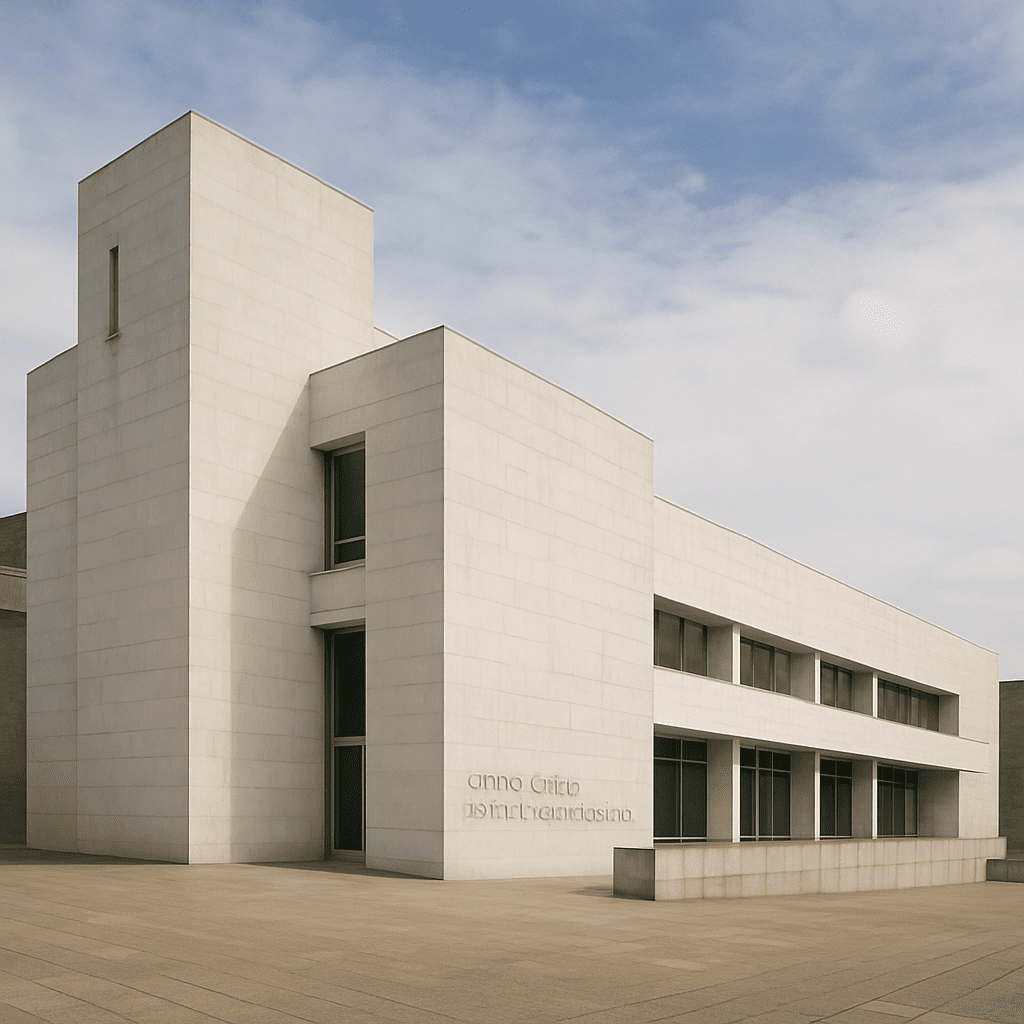
When people think of Santiago de Compostela, the first things that come to most minds are the imposing cathedral and the end of the famous Camino de Santiago. However, amidst this historic setting, a vibrant heart of modernity is hidden. The contemporary art scene Spain has found one of its most important anchor points here.
The Galician Center for Contemporary Art (Galician Centre of Contemporary Art, CGAC for short) is far more than just a museum. It is a place of dialogue where local identity meets global discourse. In this article, we take you on a journey – from the cool, elegant halls of the CGAC to the complex mechanisms of the international art market.
An architectural masterpiece meets Galician culture
When the CGAC opened in 1993, designed by the renowned Portuguese architect Álvaro Siza, it made a clear statement. The minimalist granite architecture blends respectfully into the historic streets, but at the same time breaks with convention.
Here is the Galician culture not as something past, but as something living that is constantly evolving. The museum offers a platform for local artists, but consciously places them in an international context. A fascinating element of this dynamic is the Interplay of Off-Spaces and State Museums. While the CGAC, as an official institution, facilitates large retrospectives, the small, independent project spaces in Santiago's alleyways capture the raw, unfiltered energy of young creatives. Institutions often recruit their most promising talents precisely from these underground scenes.
Behind the Scenes: Curation and Artistic Careers
What makes an exhibition at the CGAC or similar institutions so captivating? The answer lies in the invisible hands that shape them. The Areas of responsibility for a curator in the global art world They have become extremely multi-layered today. It's no longer just about hanging pictures on walls. Today, a curator is a historian, trend scout, diplomat, and storyteller all in one.
The Long Road to the Top
The curators are closely observing the Career Paths from Master Student to Established Gallery Artist. This path is rarely linear. It often begins at art academies, leads through initial group exhibitions in the aforementioned off-spaces, requires promotion by a committed gallery, and finally culminates in institutional solo exhibitions.
Curators constantly face the challenge of selecting the right artworks. But what are the Evaluation Criteria for Aesthetic and Conceptual Quality?
- Originality Does the work offer a new perspective?
- Technical Execution: Does the artist master their medium?
- Conceptual depth: Is there a strong idea behind the shape?
- Relevance Does the work address themes that reflect the current zeitgeist?
Especially the last point is crucial. Social criticism and political messages in modern exhibitions are omnipresent today. Whether it's identity politics, social inequality, or climate change – contemporary art often sees itself as a mirror and a conscience of society.

Current Trends: From Sustainability to Algorithms
The art world never stands still. If we wander through the halls of contemporary art museums today, we notice changes in materials and formats that would have been unthinkable two decades ago.
A massive trend is the use of environmentally friendly resources. Sustainable Materials in the Production of Contemporary Artworks are not just a nice extra for many young artists, but an ethical prerequisite. Sculptures made from recycled plastic from the oceans or paints based purely on plants show that the ecological footprint also plays a role in the studio.
At the same time, we are experiencing an unprecedented technological revolution. The Influence of Artificial Intelligence on Current Art Movements is hotly debated in professional circles. AI-generated images raise exciting questions about authorship and originality. This inevitably leads to the debate: Digital Art Forms versus Classical Canvas Works. While the painting retains its tactile, artisanal aura, digital works (like VR installations or NFTs) captivate with infinite reproducibility and immersive experiences.
Anyone who wants to experience this technological avant-garde live should keep an eye on urban hotspots in addition to museums like the CGAC. For example, the Berlin Gallery District as a Hub for New Media in Europe, where video art and digital installations are setting new global standards.
The Leap to Collector: The Mechanisms of the Art Market
Many visitors who regularly enjoy exhibitions eventually consider acquiring artworks themselves. However, the art market can seem intimidating to newcomers. Guide to systematically building an art collection is therefore worth its weight in gold.
How do you start a collection?
- Finding focus: Focus on a specific era, medium (e.g., photography), or region (e.g., young Galician art).
- Set budget: Art doesn't have to cost millions. Editions or paper works by established artists are often affordable.
- Research and Networking Visit exhibition openings, talk to gallerists, and subscribe to art magazines.
One of the most frequent questions from aspiring collectors is: What determines the market value of contemporary art? The price of a work of art is not an exact science, but rather a combination of various factors. These include the artist's exhibition history, acquisitions by renowned museums (such as the CGAC), mentions in art publications, and of course, the law of supply and demand.

Understand the market
Anyone who wants to delve deeper must Difference between primary and secondary market for paintings and other works of art:
- Primary Market The artwork is being sold for the first time, usually directly from the artist's studio through their representing gallery. The price is jointly determined by the gallerist and artist.
- Secondary market The artwork is resold. Pure market forces come into play here. A painting that cost 5,000 euros on the primary market can suddenly be worth 50,000 euros on the secondary market – or lose value.
The secondary market is strongly dominated by auction houses. How Auction Houses Work for Private Collectors is fascinating: An expert estimates the value of a submitted work and sets a starting price. At the auction, collectors, dealers, and museums bid against each other. The final „hammer price“ plus buyer's premium largely determines the artist's current market value.
At the same time, art fairs are the beating heart of the primary market. Significance of Art Basel for the international art trade can hardly be overestimated. It is the most important meeting point for galleries, collectors, and museum directors worldwide. What is sold here often sets the trends for the coming years.
Investing with foresight: Discovering emerging talents
Art is primarily nourishment for the soul, but it can also be a high-yield asset. How to invest in emerging talent, is an art in itself. Here are some proven strategies for art-loving investors:
- Visit open houses at art academies: Every year, art colleges open their doors. Here you can often purchase works by students at very moderate prices, long before they are discovered by a top gallery.
- Keep an eye on project and off-spaces: Observe independent spaces in creative cities or the surroundings of large museums.
- Trust your own taste, but seek professional advice. Buy art primarily because you like it. You have to live with it, after all. However, a good gallerist or independent art advisor can help you better assess the artistic substance and potential for appreciation.
- Pay attention to consistency: A talented artist is not characterized by a „lucky shot,“ but by a coherent, continuously evolving body of work.
Conclusion: The art world is open to everyone
From the quiet, light-filled halls of the Galician Centre of Contemporary Art in Santiago de Compostela to the loud bidding in the auction room – the world of contemporary art is a fascinating ecosystem. It is a place where tradition and innovation go hand in hand, where social challenges are discussed and new technological horizons are explored.
Whether you simply want to enjoy the architectural beauty and cultural exhibitions, or if you plan to actively participate in the market yourself and build your own collection: the contemporary art scene rewards everyone who immerses themselves in it with open eyes and a curious mind. Visit galleries, dare to ask questions, and let yourself be inspired by the inexhaustible creativity of our time.